The decisive moment in human settlement beyond Earth may not be the first landing, but the first child who expects to stay. An astronaut can return after the mission. A child born there needs a school, a doctor, a legal status, and adults who expect the settlement to survive long enough for her to grow old.
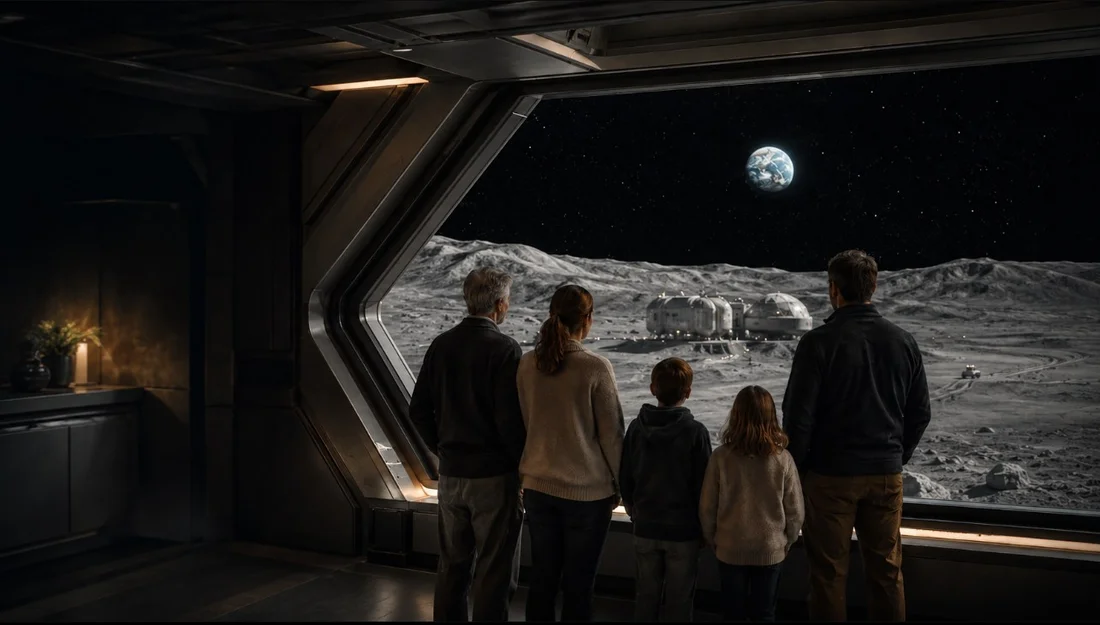
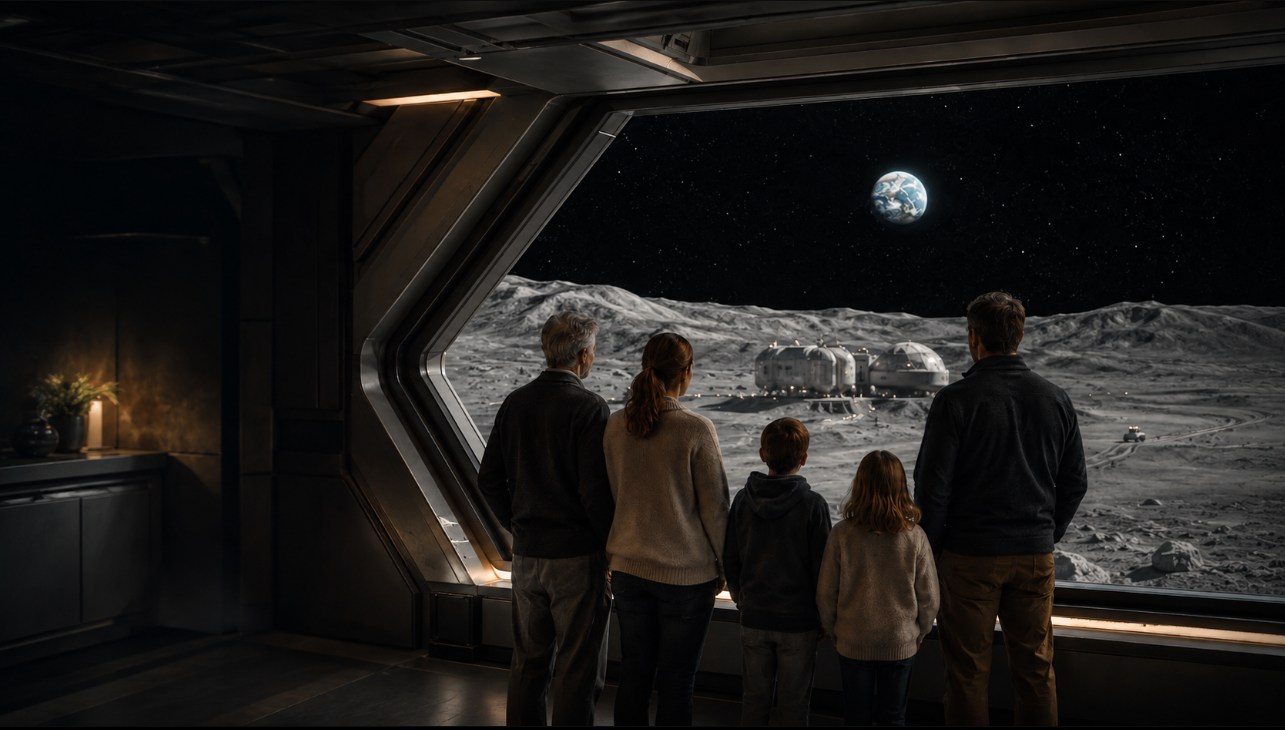
The first child who expects to stay An illustration of a family looking back at Earth from a settlement that means to remain. An astronaut can go home; a child born there needs the place to outlive her parents. via jonathanfrei.com
That is where spaceflight becomes a demographic question. A crew can explore. An outpost can depend on Earth. A settlement has to survive interruptions in that dependence. A home must make room for ordinary life and for generations that did not choose the founding mission. Reaching another world is an engineering achievement. Remaining there is a civilizational one.
The movement is not as alien as the landscape makes it look. Families turn shelter into household; neighbors turn a cluster of houses into a town; farmers, builders, teachers, and public servants receive a place and make it more habitable for successors. Reclaimed land, dependable energy, clean water, roads, schools, laws, and habits of trust enlarge the range in which human life can live well. An off-world settlement would extend that work under harsher limits. It would not release us from the work already here.
The book’s opening question placed two paths against a longer clock: a human story that remains a brief local episode, or one that lasts long enough to make a home beyond Earth. The previous chapter made the choice sharper. A civilization organized around permanent contraction may preserve remarkable comfort and technical skill, but it keeps spending the successors and spare capacity required to found. A permanently contracting humanity will not become an interplanetary civilization, much less an interstellar one.
Expansion is humanity’s longest vocation: to receive a habitable world, cultivate it, and carry life and civilization farther than one planet and one generation. That is a direction rather than a guaranteed outcome. We may discover that an independent settlement is too dangerous, too costly, or beyond what human bodies can sustain. No timetable can be defended from what we know now. The uncertainty leaves the central question intact: whether humanity preserves the ability to try, learn, refuse a bad path, and begin again.
The progression from crew to outpost to settlement to home tests that ability. It requires people, knowledge, institutions, redundancy, energy, capital, and the willingness to pursue work no founder will finish. Automation and artificial intelligence can multiply all of them, making a small team capable of work that once required thousands. They cannot become the children, citizens, friends, dissenters, or successors for whom a settlement exists.
The pages ahead move through four nested horizons. The nearest is a durable home on the Moon or Mars. Beyond it lies a harder threshold: a second branch of human civilization able to survive the loss of support from Earth and continue developing. Farther out are settlements across the Solar System and, ultimately, an interstellar civilization. The distant horizons are not predictions. They show what is contained in the word founding when the work passes through generations.
Space makes succession visible because civilization is not hardware left standing. It is people receiving a place, caring for it, changing it, and handing it forward. The stars belong inside the fertility argument because generations are the only way humanity ever reaches them.