Democracy counts the citizens who are present. Future citizens receive the results but cast no ballots, and a small generation receives fewer votes than a large one. As the electorate ages, politics acquires a built-in temptation to protect what current voters already have.
Older adults are not a political bloc. A retired renter and a wealthy homeowner may disagree about nearly everything. Older adults generally vote at higher rates than younger ones, however, while their share of eligible voters is growing. The OECD has warned that young people risk losing political weight in public decision-making.
The asymmetry is temporal as much as generational. A pension check due next month is concrete; a child who might be born five years from now has no constituency. Governments can therefore protect current consumption while sending debt or deferred maintenance to people who cannot yet object.
Housing makes the conflict visible. An older homeowner may reasonably want her neighborhood to remain as it is, while a young family needs somewhere to live. When local rules preserve scarcity year after year, the accumulated choice can turn an inherited neighborhood into an asset the next generation cannot afford to enter.
Immigration under demographic pressure
An older country needs workers, and a younger country has them. That creates a strong pull toward migration: a migrant may fill a care job and give the destination country time to adapt, while the origin country may lose the nurse it paid to train.
Immigration is therefore a powerful national adaptation with global limits. It can fill care and labor gaps, enlarge the tax base, and buy a country time to redesign work, pensions, and services. The United Nations projects immigration to be the main source of population growth through 2054 in fifty-two countries and areas. Migration changes the age and labor composition of a country; it does not increase the number of young adults in the world. More aging countries may therefore compete for a mobile pool as the number of youthful countries narrows. Receiving countries also have to do more than balance an age ratio. They have to turn arrival into shared citizenship, which requires enough trust and state capacity for newcomers and existing citizens to imagine a common future. Migrants also age, so immigration postpones rather than permanently removes the need for care, succession, and adaptation.
The next chapter will ask how much migration can accomplish as policy. Here the consequence is the pull itself: low-fertility countries increasingly depend on people born elsewhere, while origin countries decide whether departure brings remittances and return networks or leaves a hospital without the nurse it trained.
The map of power moves
The same demographic inheritance appears between countries. Wealth, technology, and competent government can let a smaller country exercise great influence, but taxes, workers, and military recruits ultimately come from people. State capacity is not just headcount: it includes the ability to educate, administer, raise revenue, maintain infrastructure, integrate newcomers, and coordinate alliances. A smaller state can preserve substantial capability when those institutions and its inherited capital remain strong, even as repeated contraction narrows its room to replace specialists.
Demographic strength can enlarge a country’s power, but power is not the purpose of a population. A government that values children principally as future soldiers, workers, or instruments of national competition repeats the error of the state that treats births as quotas. National capacity is worth preserving because it can protect a common life and contribute beyond its borders, not because a larger population gives its rulers more weight to throw around.
The United Nations’ medium projection shows how far the map could move. China falls from about 1.42 billion people in 2024 to 633 million in 2100, while India remains near 1.5 billion and Nigeria is projected to exceed the United States by century’s end. These are conditional projections, not appointments with fate. They are enough to make the twentieth-century distribution of demographic weight look temporary.
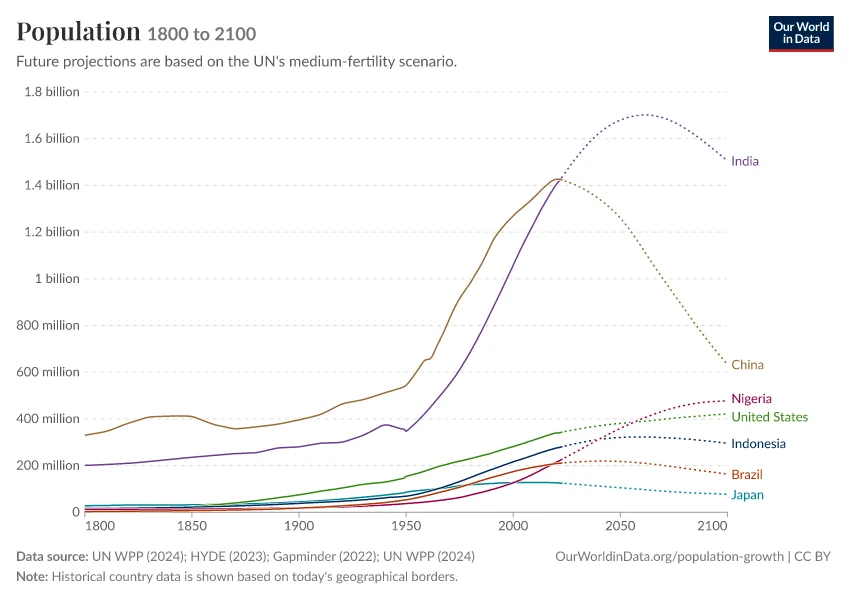
Who will have the people UN medium-variant projections through 2100. China falls; India remains large; Nigeria is projected to overtake the United States. These are conditional forecasts, not appointments with fate. Our World in Data
A youthful population becomes power only when people can learn and find productive work. An aging rich country begins with immense accumulated capital and fewer people to sustain it. The young country has to develop its people; the old one has to renew them.
Modern weapons and automation can reduce the number of people required for some forms of national power. They also increase the value of scarce technical skill, industrial capacity, alliances, and competent government. Population supplies possible recruits and workers; it does not turn them into capability by itself. Over one generation, rich aging states can draw on enormous inherited advantages. Over a century, countries that successfully educate growing populations gain more room to act.
Demographic change rearranges power slowly enough to be easy to discount. It also compounds long enough to change which countries have the people to fill laboratories, factories, armies, and eventually the institutions that set international rules. These are conditional scenarios, not a geopolitical destiny or a moral penalty. They show why national adaptation can preserve agency while the distribution of demographic weight still changes.
Citations
- Organisation for Economic Co-operation and Development, “Participation and representation of young people in public and political life”, in Governance for Youth, Trust and Intergenerational Justice, 2020.
- United Nations Department of Economic and Social Affairs, Population Division, World Population Prospects 2024: Summary of Results, 2024.