Longer life is an achievement. The problem begins when long-lived generations are followed by much smaller ones. A healthy seventy-year-old may still work, travel, and watch her grandchildren; twenty years later she may need someone else to help her stand. Longevity creates more years, with changing chances of illness and disability; low births determine how large the younger pool is when those years arrive. The two pressures interact, but they are not the same cause.
The familiar population pyramid once had a wide base of children and narrowed toward old age. In a low-fertility country it becomes a column and eventually begins to turn upside down, with large generations moving into retirement while smaller cohorts follow them into work.

Japan’s age structure, 2023 The old pyramid shape is gone: a large bulge around ages 70–75 sits above a narrowing base of children. Statistics Bureau of Japan, October 1, 2023. via Wikimedia Commons

Counting support, not birthdays
The old-age dependency ratio compares people above a conventional retirement age with people of conventional working age. Across the OECD, there were 33 people age sixty-five or older for every hundred people ages twenty to sixty-four in 2025; the organization projects 52 by 2050. That ratio is a planning signal, not a count of who can contribute. National migration can change a country’s age and labor structure, while low births change the size of the cohorts behind it; neither distinction is visible in the ratio alone.
Sixty-five is an administrative line, not a biological one. A seventy-year-old running a business and caring for grandchildren is not usefully described as dependent, which is why the World Health Organization defines healthy aging through functional ability instead. Someone may have a chronic condition and still manage a household; someone else may need help with bathing or getting across a room while remaining fully capable of choosing how to live. Chronological age, functional ability, years lived in good health, and intensive daily care are related measures, not synonyms.
Healthier aging can soften the demographic shift considerably. Across OECD countries, life expectancy at sixty-five rose by six years between 1970 and 2023. If more of those years remain healthy, people can work longer, care for grandchildren, and support others rather than receive care themselves.
The difficult period comes later, and its primary driver here is longevity: more people survive into the ages when intensive help is more common. WHO reports that the proportion of life spent in good health has remained broadly constant globally, so longer lives have also brought additional years of limitation; meanwhile, the OECD projects Korea’s share over eighty to rise from 4.4 percent in 2023 to 16.5 percent in 2050. Low births do not create those late-life needs, but they leave a smaller working-age pool to share them. Supporting active retirees is one problem. Providing daily help to a much larger population in its eighties and nineties is another.
Medicine may add years to life faster than it adds nurses to a ward, but this is not a universal law. Care intensity, workforce design, national migration, technology, family arrangements, and the organization of services mediate the mismatch. A lifting device can protect an aide’s back; remote monitoring can catch a fall; a better-trained home-care team can let someone remain in a familiar room. None of these eliminates the need for a person to interpret a change, reassure a frightened patient, or take responsibility when a plan fails. Low births make those choices harder because the younger labor pool is narrower, not because older people have become a problem.
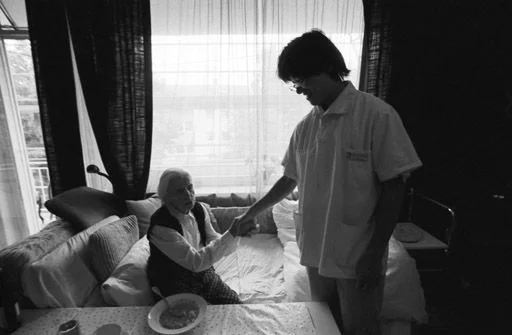
Someone has to help her stand, Munich, 1996 A young man in civilian service helping an older woman rise from the bed. Care remains personal work even when machines can move a box. via Wikimedia Commons

Scarcity creates a moral danger before it creates a budget line. An older or disabled person who needs expensive care can begin to hear herself described as a burden and eventually feel an obligation to remove it. No dependency ratio can make her life worth less, and a request to die is not fully autonomous when it grows from untreated pain, isolation, depression, fear, or the belief that care has become too costly.
An aging society should answer frailty with palliative care, companionship, protection against abuse, and institutions that do not make death feel like a civic duty. That judgment does not settle every end-of-life law or every decision to refuse burdensome treatment. It sets a boundary around the demographic argument: scarcity cannot turn another person’s dependence into evidence that her life has become a problem to solve.
Retirement ages can move as healthy life expectancy rises, and employers can make work possible for older bodies without treating every older person as a worker. Flexible hours, accessible workplaces, and later retirement can preserve service capacity; care technology and better community services can preserve independence. These changes are sensible even if fertility recovers tomorrow because the people who will be old in 2050 are already alive. What policy cannot do is retroactively enlarge the cohorts born thirty years earlier. Adaptation can buy time and dignity; it is not renewal.
One generation can adjust the boundary between work and retirement. Continued contraction changes how many people stand on either side of care. Before that arithmetic reaches a pension office, it usually reaches a family.
Citations
- Organisation for Economic Co-operation and Development, “Rapidly ageing populations will continue to put pressure on pension systems”, November 27, 2025.
- World Health Organization, “Healthy ageing and functional ability”, 2020.
- Organisation for Economic Co-operation and Development, “Life expectancy and healthy life expectancy at older ages”, in Health at a Glance 2025, 2025.
- World Health Organization, “Ageing and health”, 2025.
- Organisation for Economic Co-operation and Development, “Demographic trends”, in Health at a Glance 2025, 2025.