A woman can finish professional training at twenty-seven, establish herself at work, meet someone at thirty, marry at thirty-three, and begin trying for a first child at thirty-four. Nothing in that sequence looks like a decision against family. Most of it looks responsible. A couple who once imagined three children has nevertheless compressed nearly all of its childbearing into a few uncertain years.
That is a composite timeline, not a reported biography. Each transition is familiar in the demographic evidence; no one invented person should be made to carry the experience of millions of women and men.
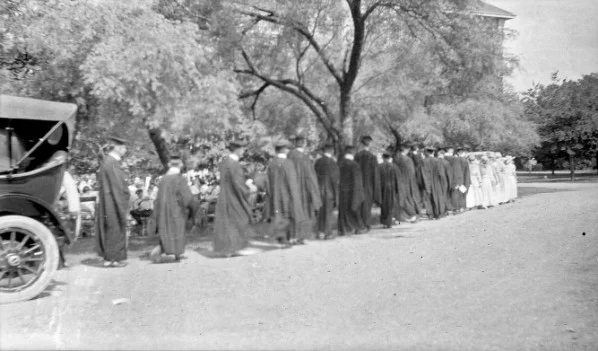
One threshold among many Young people line up for a commencement ceremony in Houston sometime between 1910 and 1940. Education enlarges freedom and opportunity; when training lasts longer, it can also move partnership, stable work, and family formation further into adulthood. Courtesy of Special Collections, University of Houston Libraries, via Wikimedia Commons

Another route begins with a man whose work remains unstable. He puts off commitment until he can offer the kind of household he thinks marriage requires. A third couple begins earlier, has one child, and discovers that housing, care, and two jobs fit together only because one parent absorbs every disruption. The second child remains wanted in the abstract and never becomes possible in practice.
Low fertility is made from all of these lives and others unlike them. Some people want no children. Some want one. Some revise what they hoped for and are content. Some never meet the right partner, encounter infertility, or reach the end of their reproductive years with a family smaller than they expected. A national rate places them in one number without making their reasons the same.
The previous chapter ended with a question that the demographic transition could not answer. Falling child mortality, urbanization, education, and reproductive control help explain why families became smaller than they were in agricultural societies. They do not explain why countries with similar prosperity and mortality settle at very different fertility levels, or why decline often continues well below replacement.
This chapter follows the thresholds through which a possible birth becomes more or less likely:
meeting → commitment → readiness → postponement → conception → pregnancy → birth → recovery → another child
The sequence branches. A person may leave it voluntarily, enter it more than once, form a family outside marriage, or never encounter some of its barriers. Its value is not that every life fits one path. It shows how several pressures can accumulate without one master cause.
Partnership can begin later. Housing and work can raise the threshold for feeling ready. Contraception makes postponement more reliable; sterilization closes reproductive capacity; abortion ends an existing pregnancy before birth. Careers and care make competing claims on the same years. Pregnancy, miscarriage, a difficult birth, and postpartum recovery can change whether a wanted first child is followed by a second or third. Digital life changes how people meet and how easily solitude continues. Female and male biology eventually make part of the delay irrecoverable, and reproductive technology cannot simply return the time that passed.
Many of those changes contain real goods. Women gained education, financial independence, and greater control over pregnancy. Adults gained more freedom to reject a bad match. Children survive and receive more care and investment. Any causal account that treats those achievements as errors will misunderstand both the history and the people living inside it.
Freedom is not the whole explanation either. A person can choose each step and still dislike where the sequence ends. The United Nations Population Fund’s 2025 survey across fourteen countries found that nearly one in five reproductive-age respondents expected not to have the number of children they desired. That measure has limits: desire is not intention, expectation can change, and fourteen countries are not the world. It still reveals that control over avoiding births and the capacity to have a hoped-for family are not the same freedom.
The argument that follows is therefore multicausal, and its moral judgments will be stated as judgments. It will distinguish a direct mechanism from its population-level magnitude, a medical circumstance from a chosen means, and a moral conclusion from a legal or policy prescription. The purpose is not to make persons serve a fertility target. It is to understand why family life became less attainable and less aspirational, then carry those obstacles forward as challenges to solve. Institutions and choices can be judged by whether they help people form durable families, honor embodied responsibility, protect vulnerable life, and welcome children as persons rather than projects or demographic instruments.
The first threshold comes before the price of housing or the limits of fertility treatment. We begin with partnership: whether two people meet and make a common future definite enough for a child.
Citations
- United Nations Population Fund, State of World Population 2025: The Real Fertility Crisis, 2025.