Posts – page 54 of 74
-
Find the SPF for you
-
Why there are so many competing standards. (via xkcd: Standards )
Why there are so many competing standards. (via xkcd: Standards)
-
Soccer and volleyball are too easy for these athletes. Kung Fu Volleyball or…
Soccer and volleyball are too easy for these athletes.
Kung Fu Volleyball or Kung Fu Soccer? (by DailyEpicVideos)
-
Pixelated animals. bifanoland : 3/10 in my pixel animal series. The age old…
-
The frame is not big enough to hold the painting . Via Super Punch
-
Live Your Dream manifesto via HOLSTEE .
Live Your Dream manifesto via HOLSTEE.
-
Extreme pointillism
by Graphic Nothing @ Some Prints.
This reminds me of an ultra pixellated version I posted in May. Again, it’s an incredible example of how the brain is able to recognize and reconstruct images in the imagination just from a few simple suggestions and component parts.
-
STATES UNITED LETTERPRESS by beauchamping on Etsy )
-
Believe in yourself
-
Synchronized sky diving inside a Prague wind funnel. Just think of the Ok Go…
Synchronized sky diving inside a Prague wind funnel. Just think of the Ok Go video where they’re all on the treadmills, but instead of treadmills they’re flying.
Praha Opening (by RaphCoudray)
-
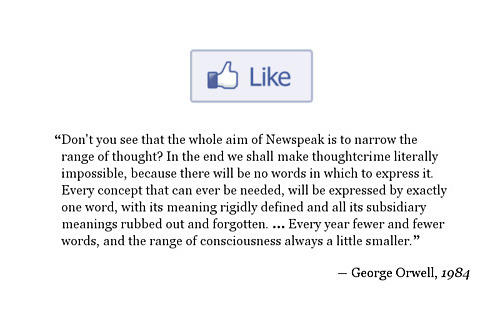
Newspeak (via reddit )
Newspeak (via reddit)
-
Ninja via Dilbert.com
Ninja via Dilbert.com
-
No, economists are not psychic
Below is a quote from John Gray’s review of David Brooks’ book, The Social Animal: The Hidden Sources of Love, Character, and Achievement. He’s talking about how the recent economic crisis was supposed to be impossible because of the psychic ability of quantitative models to predict the future of the economy.
[M]any economists refused to accept that such a crisis was possible—captivated as they were by the belief that quantitative models could predict the future, sheltering the field from messy reality. Economists were thus incapable of perceiving the dangers that were mounting around them. The attempt to domesticate the uncertainties of the future by turning them into calculable risks was discredited by the crash. A mode of thinking that was supposed to be supremely rational has proved in practice to be little more than an exercise in harebrained cleverness.
-
How to deactivate a cat. aka, putting a cat in admin mode. A veterinarian…
How to deactivate a cat. aka, putting a cat in admin mode.
A veterinarian put standby a cat with a plier. (by fckjulien1000)
-
Grains of sand magnified to 250 times real size via Lost At E Minor: For…
-
Angry Birds Coffee Art, via Foodbeast
-
John Adams
“It is more important that innocence be protected than it is that guilt be punished, for guilt and crimes are so frequent in this world that they cannot all be punished. But if innocence itself is brought to the bar and condemned, perhaps to die, then the citizen will say, "whether I do good or whether I do evil is immaterial, for innocence itself is no protection,” and if such an idea as that were to take hold in the mind of the citizen that would be the end of security whatsoever.“
-
“You Can’t Cross a Chasm in Two Small Steps”
You Can’t Cross a Chasm in Two Small Steps
(via Lifehacker)
-
Previously, on 24 (by le nompourflickr )
Previously, on 24 (by le nompourflickr)
-
The Purpose of Universities
Tim Black write in the Sp!ked Review of Books about how universities are deviating from their primary purpose: the pursuit of knowledge. However, universities now have the expectation to be economic engines, churning out smarter workers and economic producers.
An increase in the quantity of graduates will neither create a dynamic, wealth-producing economy nor will it create the conditions for the emergence of lots of dynamic, wealth-producing individuals. Universities are not what they are currently being cracked up to be. But that leads to another problem. So deeply entrenched is the belief that, to use the words of the 1998 Dearing report, ‘Higher education has become central to the economic wellbeing of nations and individuals’, that it is becoming increasingly difficult to recall what the purpose of institutions of higher education might be. Their autonomy as academic bodies, in which one ought to be free to pursue an interest in a subject area to a higher level, has been effaced by their thoroughgoing instrumentalisation as drivers of economic growth and social mobility.