High on the saddle between Sunset Peak and Yi Tung Shan, nineteen small stone cabins sit among the grass and clouds. They have no road and, with limited exceptions such as solar equipment installed during recent conservation work, no electricity. The nearest traffic passes far below. From a distance the buildings can look like abandoned military posts, but they are the remains of Lantau Mountain Camp, a Christian summer retreat founded by missionaries working across South China nearly a century ago.
In the mid-1990s, my family stayed there several times. I remember climbing the mountain with my parents and two younger siblings, drinking fresh water along the way, and lighting the kerosene lanterns at night. Those visits are why the camp means something to me, but my family entered a story already seventy years old. The cabins had survived political disorder, a failed camp on another mountain, wartime destruction, the retreat of the missionary community that built them, and the transformation of Lantau Island below. They remain because generations of owners, churches, residents, laborers, and volunteers kept carrying what was needed up the mountain.
Hong Kong makes this kind of remoteness possible in an unusually compressed space. The territory has about 7.5 million people on 1,115 square kilometers of land, an average of roughly 6,870 people per square kilometer, while about 40 percent of that land lies within country parks and special areas. The density is concentrated rather than uniform. Kwun Tong approaches 60,000 people per square kilometer, yet ridges, reservoirs, islands, and protected slopes occupy much of the same territory.
Lantau is the largest of those islands. At 148 square kilometers, it is larger than Hong Kong Island and Kowloon combined. Its spine rises abruptly from the South China Sea through Lantau Peak at 934 meters and Sunset Peak at 869 meters, the territory’s second- and third-highest summits. Lantau Mountain Camp occupies the high saddle east of Sunset Peak, around 2,500 feet above sea level, with Yi Tung Shan rising to about 747 meters on the other side. The cabins are not far from the city in miles. They are remote because the land between them and the city is steep.

Stone cabins scattered across the Lantau ridge in 1938 Photograph attributed to Raymond Smith. source: Gwulo.
The Search for Higher Ground
The camp belongs to a larger history of hill stations in Asia. During the nineteenth and early twentieth centuries, colonial administrators, soldiers, merchants, and missionaries built retreats at altitude to escape the heat and disease of tropical lowlands. Some grew into resort towns with churches, schools, clubs, and large houses. Lantau Mountain Camp never did. Its cabins remained unusually small and severe, which is one reason recent researchers describe it as the only surviving highland retreat of its scale, configuration, and architectural type in Southeast Asia.
Its direct ancestor was a makeshift summer camp on Luofushan near Huizhou, used by Protestant missionaries from around 1907. The families who gathered there were scattered during the rest of the year across Canton, Foshan, Yangjiang, Shiqi, Shaoguan, and other parts of Guangdong. They included clergy, but also doctors, teachers, and university staff. Months of heat, disease, isolation, and work gave the summer retreat a practical purpose. It provided cooler air and physical recovery, but also other children, shared meals, worship, and companionship for families who otherwise lived far apart.
Political disorder ended the Luofushan summers. In 1922, Guangdong’s provincial governor warned the camp committee that he could no longer protect the site from bandits and robbers. The missionaries moved their retreat into British Hong Kong and tried a temporary camp below Tai Mo Shan in 1923. They again built with mat sheds. A typhoon destroyed them overnight near the end of the season.
The campers wanted to replace the sheds with stone shelters, but the government refused because the land lay within the proposed catchment for Jubilee Reservoir. Search parties went out again that autumn. They considered Ma On Shan and Lantau, then divided the Lantau reconnaissance between the Ngong Ping plateau above Tai O and the saddle between Sunset Peak and Yi Tung Shan. Both locations offered altitude and water. Ngong Ping, however, already had Chinese homes and monasteries, while the Sunset Peak party thought the saddle most resembled the lost camp at Luofushan. Colonial officials also favored Lantau because villages below could supply chickens, fish, and other provisions. The site’s geography offered more than elevation. The saddle lies across a watershed with several tributaries, open slopes for building, and routes descending north toward Tung Chung and south and east toward Mui Wo, Pui O, and the coast. Water could be caught on the ridge, but food and people still had to climb to reach it.
The choice was partly a process of elimination. The desirable high ground on Hong Kong Island had already been claimed. Tai Mo Shan had failed. Ngong Ping was occupied. In the summer of 1924, a few adventurous families tested the Sunset Peak site with mat sheds attached to a stone room that served as kitchen and storm shelter. Having watched the previous camp disappear in a typhoon, they were already learning what the mountain would require.
Negotiations with the government covered land, building permits, access trails, water protection, and whether the area could be reserved for foreigners. The lots went to auction on Christmas Eve 1924. Prospective campers coordinated their bidding beforehand so they could secure the whole group. The earliest buyers included missionaries from Britain, Ireland, the United States, Canada, the Netherlands, Australia, and New Zealand, some purchasing in their own names and others through churches or missionary societies.
Building a Life on the Ridge
A Western-trained Chinese Presbyterian contractor directed construction. Stonecutters quarried blocks just below the summit. The mountain is built largely from hard volcanic rocks, including rhyolite and tuff, whose resistance to erosion helped preserve Lantau’s high ridges and peaks. The cabins therefore rose from the geology beneath them. Cement was mixed on the mountain with local sand and stream water because hauling material to the ridge was so difficult that building there cost roughly three times as much as building below. Eleven cabins and a caretaker’s hut went up in 1925. The Mess Hall followed in 1928. More cabins appeared over the next several years on the slopes of Yi Tung Shan and nearer Sunset Peak. By 1934, the camp contained nineteen residential cabins, the Mess, a caretaker’s hut, an amah’s hut, and a swimming pool made by damming a mountain stream. Cabin 24, originally known as Dobson’s Hut, remains Hong Kong’s highest residential premises.

John Anton-Smith and an unidentified girl outside a camp hut in 1939, looking toward Tung Chung Photograph attributed to Raymond Smith. source: Gwulo.
Arthur J. May, a Methodist preacher and mission architect, produced the original cabin plan. The buildings were supposed to be alike, compact shelters about eighteen by sixteen feet with no more than three rooms. Their walls were between twelve and sixteen inches thick, topped by reinforced concrete roofs and protected by stout wooden shutters. A district officer objected that they were too small and low to be considered proper human habitation. The campers replied that seasonal mountain shelters could not reasonably be built to the same rules as lowland houses.
The cabins survived, but the objections were not entirely wrong. May had designed them around the habits of Luofushan, where families spent much of their time outdoors. Sunset Peak brought more wind, rain, cloud, and unstable weather. Some windows and doors faced the prevailing storms so badly that residents later recalled entering through windows because rain beat through the doors. Families enlarged the cabins piece by piece, adding storm entrances, lean-tos, kitchens, bunk rooms, toilets, and sitting rooms. The later walls were often only half as thick as the originals and proved adequate through many typhoons. Almost every cabin became an architectural record of correction: a simple common plan reshaped by weather and use.
The interiors demanded similar improvisation. Beds were raised when needed and stored when the same space had to become a kitchen or dining room. Gear hung from ceiling hooks. Early mattresses were cloth ticks filled with rice straw. One floor plan drawn by camp manager Carter Morgan shows a dense arrangement of bunks, tables, storage, and small domestic spaces inside the thick stone shell.
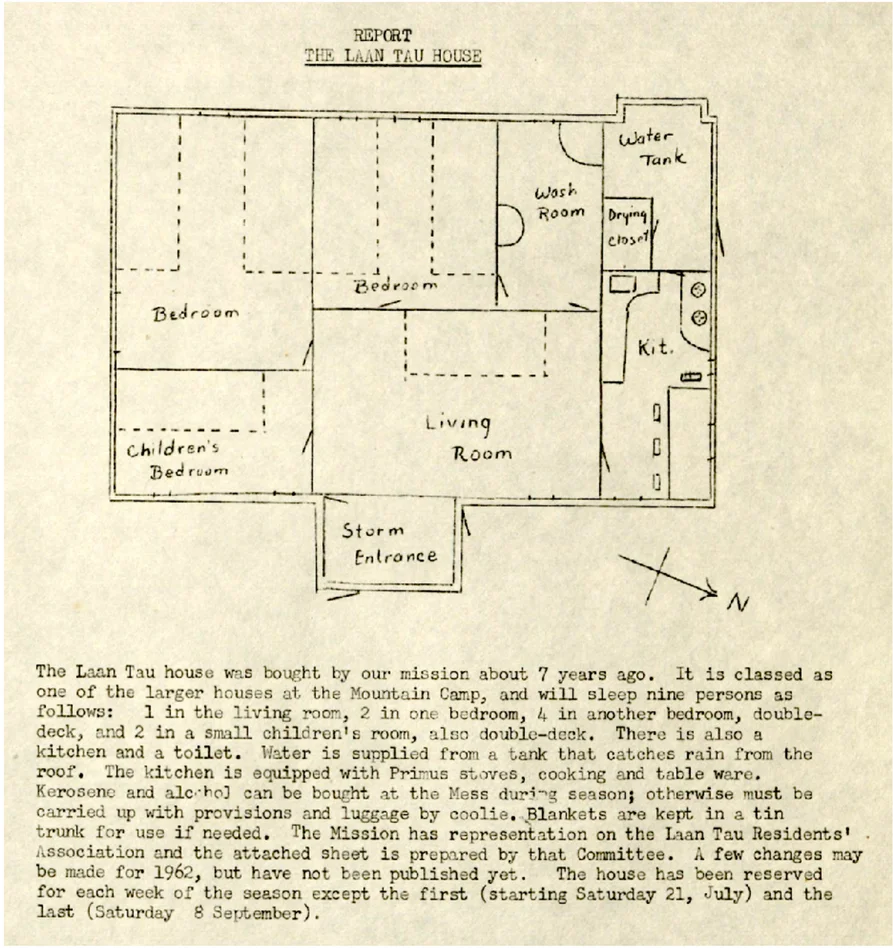
Dr. Carter Morgan’s floor plan of the Baptist cabin. Original held in the Laan Tau Mountain Camp Collection at California State University, Northridge; reproduced in Built Heritage.
The Work Behind the Simplicity
What looked like rustic simplicity rested on a large system of labor. The Caretaker’s Hut was enlarged twice to house a year-round caretaker and as many as eight carriers. During the active summer season, the carriers made daily journeys on foot with food and supplies from villages below. The caretaker maintained the common property and could reach cabins scattered across both sides of the saddle.

A rest on the journey up to Lantau Mountain Camp in 1939 Raymond Smith’s photographs of the approach also record the bearers and sedan chairs used on the climb. source: Gwulo.
Access itself was a construction project. The first trail climbed from the Tung Chung valley and was built through an agreement between the government and the prospective campers. The government paid the initial cost on the condition that the camp maintain the route to the District Officer’s satisfaction for three years. For nearly a decade it was the only way in. A second path from Mui Wo was developed in 1933 and 1934 along an older route associated with monks, with much more work completed after the war. George Stacey Kennedy-Skipton led the trail committee for more than thirty years. Repairs involved local contractors, masons who had fled China, and later prisoners from Chi Ma Wan and Ma Po Ping. The paths created to supply a private mountain camp eventually became part of Hong Kong’s public trail system.
Water had helped determine the site from the beginning. The saddle divides drainage toward opposite sides of Lantau, and several tributaries begin around it. From the open plateau, the ground falls away toward the Tung Chung valley to the north and the beaches of southern Lantau to the south. The scouting party considered it possible to dam one stream into a swimming pool. Campers spent several seasons clearing rocks, mud, and debris. In 1927 and 1928, the British Army blasted the largest rocks and built a cement face on the original mud dam. Local hikers later called the pool Tin Chi, the Heavenly Lake. A children’s paddling pool was added in 1950, seven years before Victoria Park opened Hong Kong’s first public swimming pool. Campers cleaned and disinfected the water and maintained rules for its use.
By the 1950s, many cabins had roof catchments, storage tanks, and simple gravity-fed plumbing. Drinking water could still come directly from springs. Decades later, climbing toward the camp, I remember stopping to drink the fresh mountain water on the way. I knew nothing about catchments or the years of labor behind the trails. The fresh stream water was simply one of the signs that we had left the city below.
The center of the original camp was the Mess Hall. Built in the heart of the saddle in 1928, it was dining room, storehouse, administrative headquarters, theater, and church. Announcements were made at meals. Campers put on songs, folk dances, and comic sketches. Sunday services included hymns, preaching, prayer, and offerings for Lantau schools and welfare work serving children, refugees, and families in need. The Christian identity of the camp was clear in its communal life even though the buildings carried almost no religious decoration.
The residents’ association expected owners and guests to participate. Its constitution aimed to preserve Christian fellowship as well as the owners’ practical interests. Anyone selling a cabin was encouraged to find a buyer acceptable as someone who would share the life of the community. Guests received camp notes explaining that management and catering were performed by people who were themselves on holiday. Meals required punctuality, advance notice, and help from everyone. Association meetings, held over the decades at the YMCA, Helena May, St Andrew’s Church, and church offices, opened and closed with prayer.
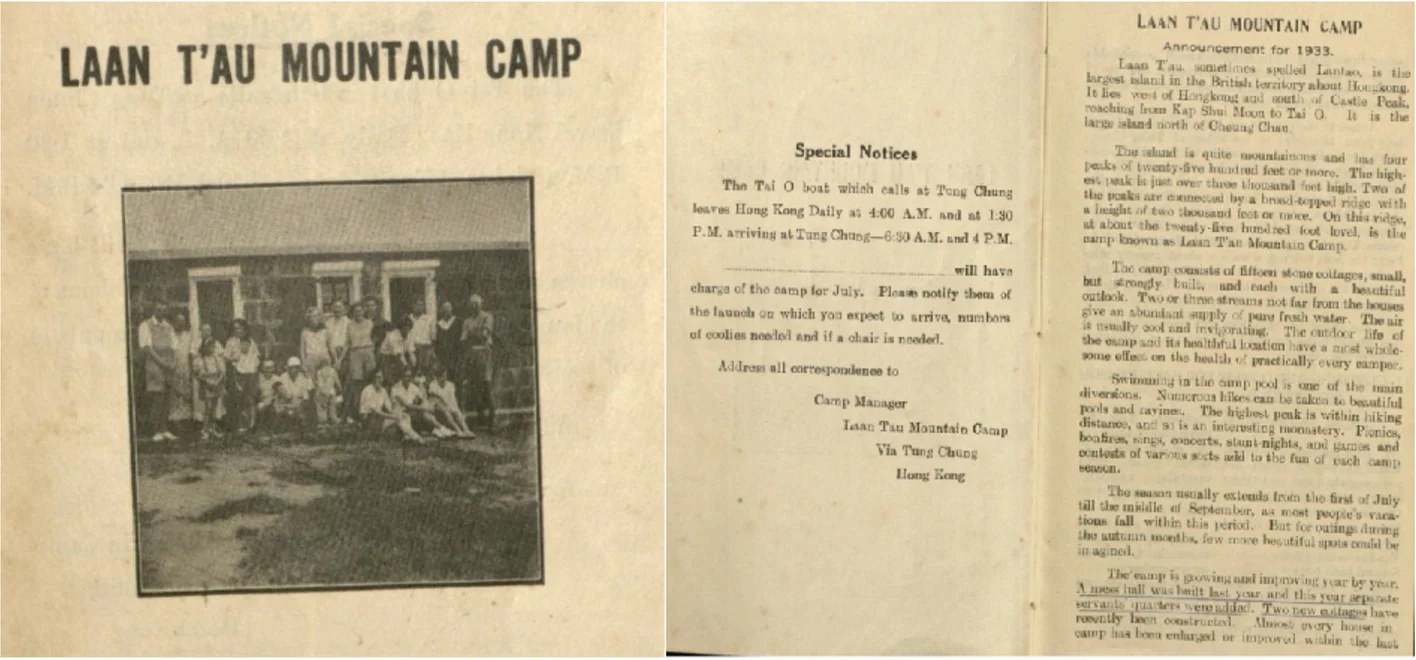
Camp notes issued for the summer of 1933. Original held in the Laan Tau Mountain Camp Collection at California State University, Northridge; reproduced in Built Heritage.
The Mess was still recognizably fulfilling that role when my family visited. I remember watching skits there and performing one with my dad: David and Goliath, with the casting adjusted so that I played Goliath and my dad played David. The performance continued a tradition of camp entertainment that reached back to the earliest campers.
Life inside the cabin preserved smaller habits of self-sufficiency. My mother cooked our meal over a gas stove. Kerosene lanterns supplied the light. I remember standing beside my dad while he shaved with a safety razor; I covered my own face with shaving cream and removed it with a spoon. Outside, my siblings and I made little gardens from the moss, including moss landscapes for my G.I. Joes. These memories do not explain the history of the camp. They show what the cabins were built to contain: ordinary family life made slightly strange by altitude, carried provisions, and the distance from the city’s machinery.
Destruction and Return
The community that built that life nearly lost it during the Second World War. The camp closed under the Japanese occupation. Most of the buildings were heavily damaged, and reinforced concrete roofs were broken apart for the steel inside. Only two cabins reportedly escaped serious destruction because guerrillas used them as lookout posts. When owners returned after the war, the damage was discouraging. One early inspection party found Kennedy-Skipton at the ruined Mess Hall, already heating water for coffee over a fire. Repairs proceeded cabin by cabin while Hong Kong itself was rebuilding. The seams near the tops of many walls still show where new concrete met the prewar stone.
The postwar decades restored the summer camp. Owners were encouraged to rent their cabins during the season, bringing church groups and other vacationers into its communal routines. Cabins adopted numbers in 1956, replacing or supplementing the names of owners and missionary societies. The pool was maintained, the Mess operated, carriers moved supplies, and the association continued to manage the roads, water, common buildings, rentals, and rules.
The social foundation nevertheless shifted. Until the late 1960s, cabin owners and their representatives were mostly missionaries: clergy, doctors, and teachers. As overseas missions withdrew or moved elsewhere and Hong Kong churches became more local, practising Christians from other professions took a larger role. Government officers and professionals in architecture, education, science, forestry, and public works brought skills useful for maintaining an exposed settlement. The first individual Chinese Hong Kong owner joined in 1977. Church and missionary organizations retained some cabins, while others passed into private hands.
The year-round caretaker service ended in 1973. Major missionary participation declined through the late 1970s, and the organized summer camp ceased operating in the late 1980s. Owners and guests began making shorter visits, often on weekends or during cooler months, when the weather was more stable. Church volunteers still climbed to repair cabins and preserve them for youth retreats, but fewer people were on the mountain together, and the Mess was no longer central to every visit.
The surrounding land was changing too. Lantau South Country Park protects the island’s rugged southern mountains and coast, while the camp sits where the northern and southern protected landscapes meet around the high ridge. The creation of Lantau North and South Country Parks in 1978 gave official protection to much of the landscape while leaving the privately held camp as the Yi Tung Shan enclave. The seventy-kilometer Lantau Trail opened in 1984, incorporating paths that had once existed primarily to serve the cabins. The camp became easier to encounter without becoming easier to inhabit.
The Camp My Family Found
My family arrived in this quieter period. We were there as part of the missionary summer season, and the old material and social patterns remained. The climb was still part of experience. Meals still came from what had been carried up. Children still made their own entertainment. The Mess could still host the entertainment. When a typhoon approached, we closed the heavy wooden shutters. I remember lying in bed trying to sleep while the wind shook the cabin. The same shutters and thick walls had been devised by families who had already watched one temporary mountain camp blow away.
During those same years, north Lantau below us was being transformed for a new airport, Tung Chung New Town, and the roads and railways that would connect them to Hong Kong. The geography makes that contrast visible from the camp itself. To the north are Tung Chung, the airport, and the Pearl River approaches; to the south lie Pui O, the three-kilometer beach at Cheung Sha, and the South China Sea. Ferries pass between Lantau and the outlying islands. On a clear day, views can extend toward Kowloon, Shenzhen, Cheung Chau, and the urban horizon. Clouds can erase all of it within minutes.
The contrast is tempting as a symbol, but the camp was not simply frozen while the modern city advanced. It had changed continually. Its buildings survived because people modified them, repaired them, changed ownership arrangements, shortened visits, and found new reasons to climb. What remained constant was that the mountain set the terms.
From Retreat to Public Landscape
The camp now faces the consequences of being widely visible while remaining difficult to understand. Sunset Peak has become one of Hong Kong’s most popular hiking destinations, especially when autumn silvergrass covers the exposed upland slopes. The seventy-kilometer Lantau Trail crosses the island in twelve sections; its early stages follow rugged ridges over Yi Tung Shan, Sunset Peak, Pak Kung Au, and Lantau Peak. A modern route promoted by the Hong Kong Tourism Board covers about nine kilometers and takes roughly four and a half hours, climbing from a road pass into forest and then out onto open grassland before descending toward Nam Shan and Mui Wo. The cabins appear on social media and in countless hiking photographs. Eason Chan’s 2010 album Taste the Atmosphere, photographed in the area, gave another generation an image to recreate. In 2025, crowds included visitors from mainland China who had come specifically to find the album landscape.
Many hikers do not realize that the cabins are private and still in use. The lack of signs and religious symbols makes them easy to mistake for abandoned shelters or military ruins. Visitors have climbed onto roofs, picnicked against walls, camped around cabins, broken in, smoked on the dry hillside, and pulled silvergrass. Owners generally accept that the public has a right to enjoy the surrounding country park, but they have also maintained buildings and paths at private expense for decades. From their perspective, the camp has become public scenery without becoming public property.
The pressure has forced Hong Kong to decide what kind of place it wants to preserve. The answer remains divided among agencies. The Antiquities Advisory Board has not graded the cabin cluster as historical buildings. The Agriculture, Fisheries and Conservation Department approaches the area primarily as protected landscape and recreation. The Sustainable Lantau Office and Civil Engineering and Development Department have emphasized cultural history and rural conservation. Owners, churches, hikers, ecologists, and heritage researchers bring still other priorities.
Keeping the Camp Alive
That fragmented status has not prevented serious work. The Sustainable Lantau Office commissioned a comprehensive historical study and conservation strategy completed in 2022. A Chinese University of Hong Kong team led by Professor Thomas Chung then launched the Regenerating Lantau Mountain Camp project, supported by HK$12.5 million from the Lantau Conservation Fund. The three-year program combined architectural research, ecological and biodiversity surveys, visitor-impact studies, oral history, public education, a conservation management plan, and the restoration of the 1925 Caretaker’s Hut.
The hut had been unused for more than thirty years. Conservators repaired unstable exterior walls, doors, windows, interior finishes, floors, and surviving original details. They retained its low L-shaped arrangement of entrance, rest area, storage room, and toilet while adapting it into a working support station. Solar panels supply limited electricity. The station has filtered rainwater, an ecological toilet, bunks, and storage for conservation and emergency work.
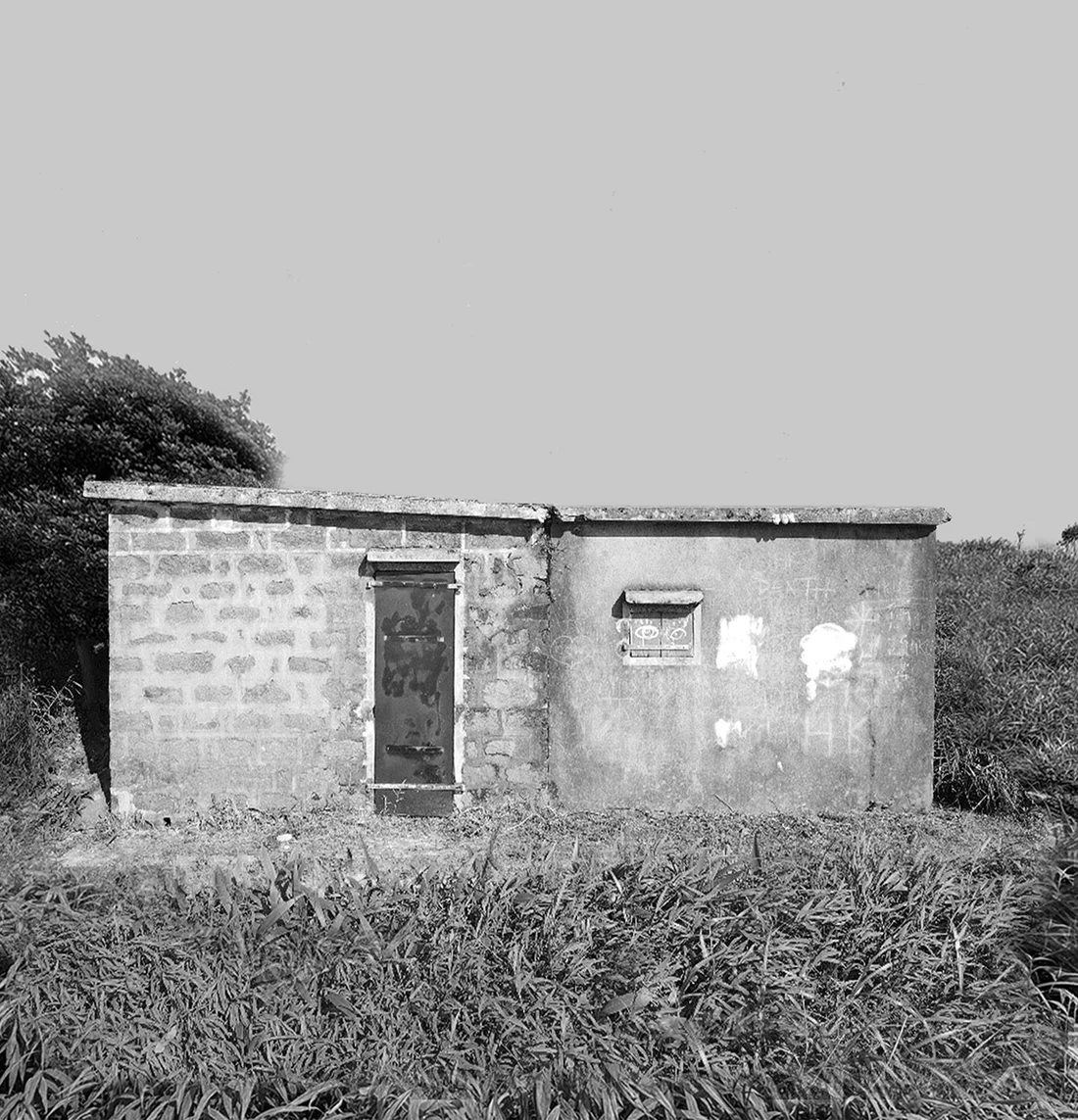
The Caretaker’s Hut before restoration source: Regenerating Lantau Mountain Camp.

The restored hut now supports conservation research, visitor education, and emergency readiness source: Regenerating Lantau Mountain Camp.
The restored hut is not new tourist accommodation. It is a base for the people trying to care for the mountain. Conservation Guardians trained with Raleigh International Hong Kong periodically staff it, conduct ecological surveys, assess visitor impact, explain the camp’s history, and teach leave-no-trace practices. The wider project has run guided nature tours, historical workshops, stargazing, mountain-safety activities, and a bilingual virtual-reality record of culturally and ecologically significant sites. Its stated next steps include further building repair, continued environmental monitoring, and broader education.
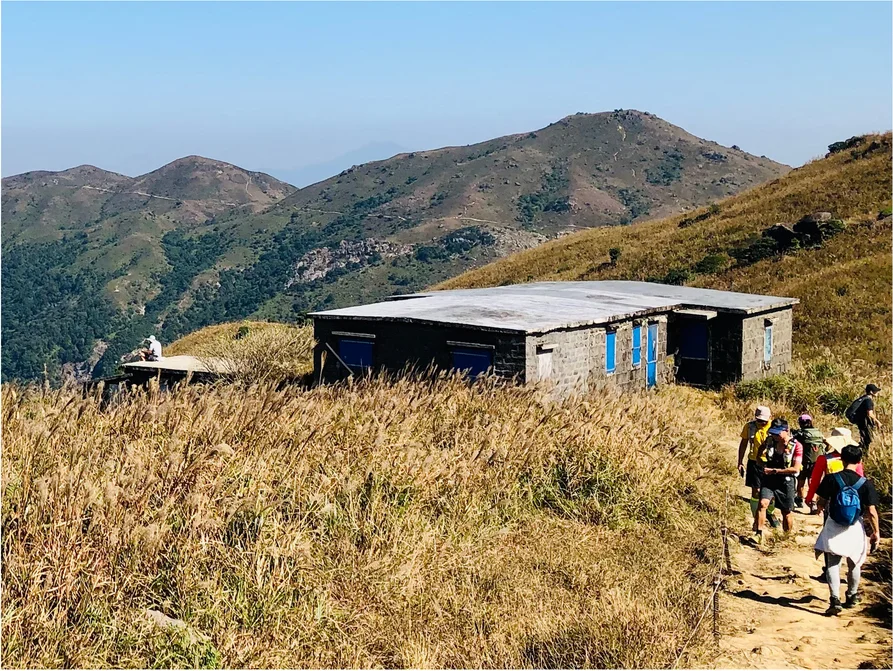
Hikers pass the 1928 Mess Hall in November 2022 Photograph by Miriam Lee. Reproduced in Built Heritage.
The approach recognizes that the camp’s history cannot be separated from continued use. It is not a ruin waiting for the government to assign it a function. Some cabins remain with churches and institutions connected to early owners; others belong to individuals. Volunteers still repair church cabins so retreats can continue. Owners and guests still go up for quiet and the mountain air. The buildings have survived as private dwellings, religious inheritance, and working shelters even while the surrounding paths became public.
A conventional museum might protect the stones while ending that continuity. Unmanaged popularity could preserve the camp’s image while damaging the buildings, ecology, and privacy that give it substance. The more difficult work is to protect a living place without making it inaccessible, and to welcome public interest without turning every cabin into a prop.
The Caretaker’s Hut offers a modest answer to what preservation might mean here. It was not frozen in its original form or converted into accommodation for hikers. It was repaired so it could once again support the people responsible for the mountain. Its purpose has changed, but it has a purpose.
Lantau Mountain Camp has survived through a century of such adaptations. The cabins were altered when their original designs proved unequal to the weather, rebuilt after the war, passed from missionaries to churches and private owners, and repaired by people willing to carry materials uphill. The camp endured because it remained useful to people who thought it worth the trouble.
Nearly everything that made the camp difficult also helped preserve it. The climb restricted development. The lack of a road discouraged replacement. The absence of ordinary utilities kept its comforts simple and its use deliberate. But inconvenience alone preserves nothing. Without owners, carriers, caretakers, church volunteers, and conservation workers, the cabins would long ago have become ruins.
The challenge now is not to remove every difficulty, but to sustain the human commitment that has always answered it. What the camp was, what it is, and what it may become have always depended on what people were willing to carry to the ridge: stone and cement, food and fuel, tools and timber, responsibility and care. Whatever future Hong Kong chooses for Lantau Mountain Camp will still have to be carried up the mountain.