A straight line is a surprisingly powerful thing to mistake for nature.
In 1966, the linguist Robert B. Kaplan published a paper about a problem he kept seeing in the writing of international students at American universities. Many of them knew English quite well. Their grammar worked. Their vocabulary worked. Their sentences, taken one at a time, worked. And yet their essays could still feel strangely difficult to an American reader. The argument seemed to wander, repeat itself, arrive late, or refuse to arrive at all.
Kaplan wondered whether the problem was happening above the level of the sentence. Perhaps students had learned the words and grammar of English without learning an equally real but less visible part of the language: the expected shape of an argument.
He eventually reduced the idea to five little drawings.
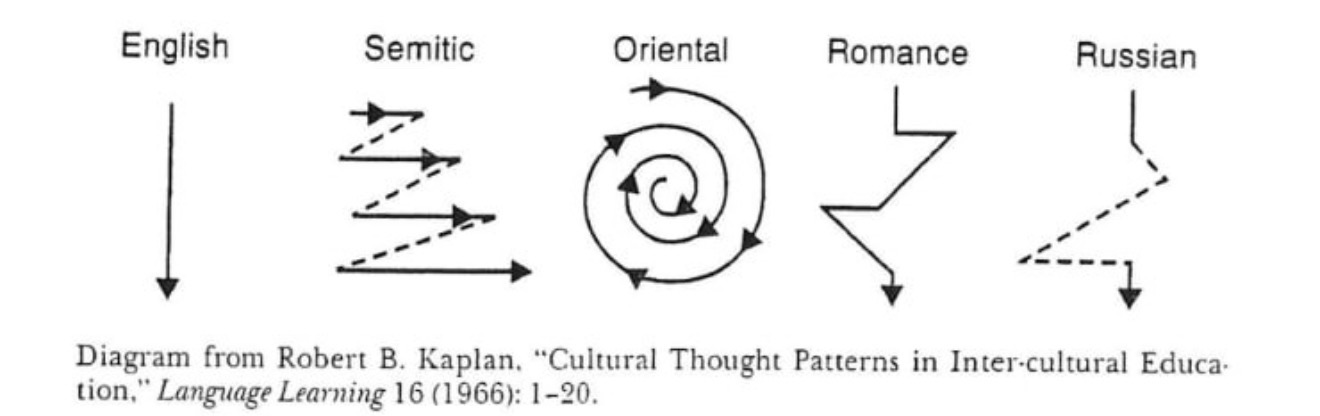
The first is a straight line. That is English. Another moves back and forth in parallel lines, representing what Kaplan called Semitic languages. A spiral represents what he called Oriental languages. Romance and Russian writing wander away from the central line in different kinds of digressions.
It is the sort of diagram that is almost impossible to forget and probably too easy to believe.
Kaplan’s original article, “Cultural Thought Patterns in Inter-Cultural Education,” became one of the foundational texts of what came to be called contrastive rhetoric. He had examined roughly 600 compositions written by foreign students and argued that rhetorical organization was not simply a neutral container into which ideas were poured. Different cultures had developed different conventions for arranging ideas, and students carried some of those habits with them when they wrote in English.
His strongest version of the claim went further. “Logic,” he wrote, using the word in its everyday rather than formal sense, “is evolved out of a culture; it is not universal.” English prose inherited a broadly Anglo-European preference for linear development: establish the subject, state or imply the controlling idea, and then proceed toward it without unnecessary detours. Other rhetorical traditions had developed differently.
Kaplan was not saying that an Arabic speaker was incapable of linear thought or that a Japanese speaker literally thought in circles. He explicitly warned that his categories were not mutually exclusive, and he noted that English writers could be circular or wildly digressive too. His concern was expository prose and, more specifically, what a reader had been trained to recognize as a well-made paragraph. The practical conclusion was modest enough: if we explicitly teach foreign students English grammar, perhaps we should also explicitly teach them English rhetorical conventions.
Still, the drawings invited a much bigger interpretation than the caveats could contain.
A straight line looks efficient. A spiral looks evasive. Once English occupies the position of directness, the other patterns can begin to look like deviations from clear thought rather than alternative conventions for communicating it. The terminology has aged even worse. Grouping Chinese, Korean, and Japanese writing under “Oriental,” or treating enormous linguistic and literary traditions as though each possessed a characteristic doodle, now looks impossibly broad.
Later scholars made those objections directly. Ryuko Kubota and Al Lehner argued in “Toward critical contrastive rhetoric” that the traditional model encouraged static binaries: English as linear, direct, and logical; other traditions as circular, indirect, or digressive. It could turn a useful observation about convention into a story about deficiency. There was also a basic problem with Kaplan’s evidence. He was looking largely at English compositions written by students learning English, then reasoning backward from those texts toward the rhetorical character of their first languages and cultures. A student essay written under the strain of a second language is a rather shaky foundation for a theory of civilization.
The field Kaplan helped create gradually became more careful. Ulla Connor’s later account of intercultural rhetoric moved away from treating national cultures as fixed rhetorical systems and toward studying genres, institutions, discourse communities, individual writers, and the circumstances in which a text is produced. A Chinese engineering paper, a Japanese sales letter, and a Korean university essay do not become instances of one spiral simply because their authors come from East Asia. A lawyer and a novelist writing in the same language may have more immediate rhetorical differences than two lawyers writing in different ones.
That correction makes Kaplan’s diagram less grand. I think it also makes the part worth keeping easier to see.
The straight line is not a picture of the English-speaking mind. It is a picture of an expectation.
If you grew up writing essays in English, you probably absorbed that expectation so early that it stopped feeling like a convention. School taught you to state a thesis, give the reader a topic sentence, support the claim, remove the irrelevant material, and make the relationship between one paragraph and the next visible. “Get to the point” sounds like advice about thinking, but it is also advice about the obligations a writer has toward a particular kind of reader.
Once enough people share those obligations, they disappear into the background. The writer knows where the thesis belongs. The reader knows where to look for it. A paragraph that announces its subject and then develops it feels orderly because both people have learned the same dance. Someone trained in another convention can violate those expectations while making perfectly sensible choices according to a different set of them.
We do this in smaller ways all the time. A legal brief, a newspaper story, a scientific paper, and a personal essay can contain the same facts and arrange them almost beyond recognition. The newspaper writer may put the conclusion in the first sentence. The scientist may spend pages establishing method before reaching it. The lawyer may lead with the rule and organize every fact around its application. A personal essay can withhold its point until the last paragraph and be better for it. Nobody concludes that the scientist thinks less directly than the reporter. We understand that each form has inherited expectations about what the reader needs, when the reader needs it, and how much work the reader should be asked to do.
Culture works on writing in a messier version of the same way. So do education, profession, class, religion, genre, audience, and individual temperament. They overlap. They change. Writers learn new forms and deliberately break old ones. This is a much less satisfying theory to draw on a chalkboard because it probably requires hundreds of intersecting lines instead of five memorable doodles.
But Kaplan saw something real when he noticed that grammatical correctness did not solve his students’ problem. They were encountering a layer of language that native speakers often fail to notice precisely because they have mastered it. The students were not merely learning how English sentences work. They were learning what an English-speaking academic reader had been trained to expect an argument to do.
That observation has consequences beyond the ESL classroom. We routinely confuse conventions with universals when the conventions are old enough and familiar enough. Table manners feel like manners rather than one culture’s manners. Our sense of appropriate distance in conversation feels like appropriate distance. A meeting that begins without small talk can feel rude to one person and admirably efficient to another. The invisible rules are most invisible to the people who know them best.
Writing may be especially prone to this confusion because prose gives us access to another person’s thoughts only after those thoughts have been arranged for us. When the arrangement matches our expectations, we call the writing clear. When it does not, we may conclude that the thinking behind it is confused. Sometimes it is. Sometimes the writer simply failed to follow the conventions of the audience. Those are not the same failure.
There is also a useful humility in realizing that English’s straight line is not quite as straight as the diagram suggests. Good English prose constantly violates the schoolroom version of linearity. It delays information for suspense, digresses for texture, repeats for rhythm, approaches difficult subjects obliquely, and lets an image carry an argument that could have been stated directly. Kaplan himself acknowledged literary exceptions. Even expository English has more freedom than the doodle gives it. Kubota and Lehner’s critique points out that actual English-language school texts do not always obey the simple direct-and-deductive model that students are often taught as the English pattern.
The convention remains useful anyway. If I am trying to explain a complicated idea, the straight line is usually a pretty good place to begin. I want the reader to know what I am talking about. I want each paragraph to earn its place. I don’t want a detour to exist merely because I enjoyed taking it. Those preferences are so deeply embedded in how I learned to write that they feel almost indistinguishable from good writing itself.
Kaplan’s diagram is a reminder to separate those two claims. Some writing really is muddled. Some arguments really do evade the evidence, lose their subject, or bury the point beneath material that does not belong. But clarity always has an audience, and an audience arrives with habits. We can judge an argument while still recognizing that some of the standards by which we judge its presentation were taught to us.
The old doodles are too crude to tell us how cultures think. They may be just crude enough to show us that our own straight line was learned too.