There is something wonderfully ambitious about trying to draw the history of government as a circle.
Sometime in the second century BCE, the Greek historian Polybius tried to do roughly that. In Book VI of his Histories, he described a recurring sequence by which political orders emerge, mature, corrupt themselves, collapse, and begin again. The theory is usually called anacyclosis—a cycling or recurring movement—and it gives us one of antiquity’s most memorable attempts to turn political history into a pattern.
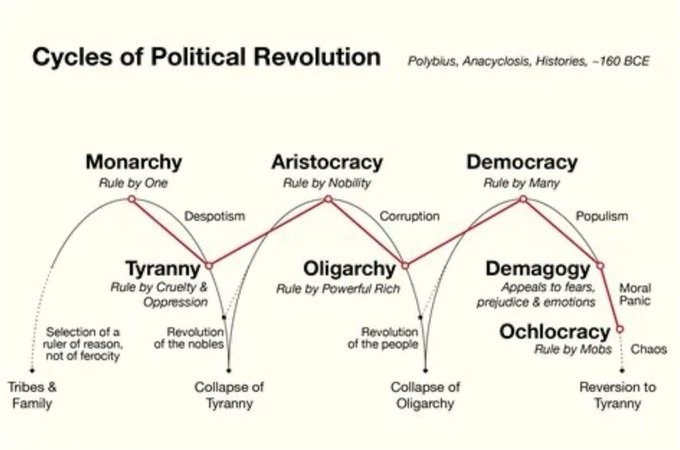
The diagram makes the theory look almost mechanical. Monarchy becomes tyranny. Aristocracy becomes oligarchy. Democracy becomes mob rule. Disorder eventually produces another ruler, and the wheel begins another turn.
Polybius’ actual argument is more interesting than the diagram because the mechanism isn’t really constitutional. It’s human.
Polybius inherited a familiar Greek way of classifying governments. Plato and Aristotle had already distinguished political systems according to whether power rested with one person, a few, or the many, and whether those rulers governed well or badly. Polybius turned those categories into a story unfolding through time.
He begins before anything we would recognize as a constitution. After catastrophe scatters and weakens human communities, people gather together again. The strongest person naturally assumes leadership. Strength alone, however, isn’t yet kingship. A king emerges when people begin to recognize justice and choose to follow a ruler for his judgment rather than merely fear his power. Political authority has moved from force toward legitimacy.
Then the children inherit it.
This is the recurring hinge in Polybius’ cycle. The generation that creates an institution usually remembers why it exists. The generation that inherits it receives the institution without necessarily receiving the experiences that produced it.
The first kings, in Polybius’ telling, live much like everyone else. Their descendants grow up surrounded by security, status, and abundance. They begin to expect special clothes, special food, special treatment, and the satisfaction of their appetites. Kingship becomes tyranny. The ruler who once governed because people trusted his judgment now governs through fear.
The tyrant eventually produces his own opposition. Polybius says the people most likely to resist are the noblest and most courageous citizens, precisely because they are least willing to tolerate his arrogance. They overthrow him, and because they have liberated the community, the people entrust them with government. Tyranny gives way to aristocracy: rule by the few who have demonstrated enough virtue to deserve it.
And then their children inherit it.
The pattern repeats. The founders of the aristocracy remember oppression and treat public office as a responsibility. Their descendants have known neither oppression nor equality. Some become greedy; others indulgent; political authority becomes a possession rather than a trust. Aristocracy decays into oligarchy.
Eventually the people have enough. The oligarchs are killed or driven out, but the memory of both monarchy and aristocracy is now poisoned. The citizens will not hand power back to one man or a small group, so they take responsibility for government themselves. Democracy is born.
At first, Polybius says, the memory of oligarchy keeps democracy healthy. People who remember losing their freedom value equality, law, and freedom of speech because they know what their absence feels like. But memory fades again. By the time government passes to the grandchildren of the democratic founders, those goods have become ordinary. Ambitious wealthy men discover that they can gain power by courting and corrupting the people. Citizens grow accustomed to receiving benefits from political patrons. Competition for popular favor becomes a competition in indulgence.
Democracy then becomes what Polybius calls ochlocracy—usually translated as mob rule. Law loses its authority. Political contests become contests of force. The crowd can plunder, banish, and kill. Eventually the community reaches something close to the savage condition from which the cycle began, and in the chaos it again accepts a master capable of restoring order.
The wheel has made a complete turn.
The grandchildren problem
It’s tempting to read anacyclosis mainly as a taxonomy of governments. I think it’s more revealing as a theory of inheritance.
Again and again, Polybius locates political decay in the distance between the generation that learned a lesson and the generation that merely inherited its result. The king’s descendants inherit authority without remembering the conditions that made authority legitimate. The aristocrats’ descendants inherit prestige without the courage that earned it. The grandchildren of the democratic revolution inherit liberty without remembering domination.
The institution survives. The memory that disciplined it does not.
That helps explain why Polybius treats constitutional decline almost like a natural process. He compares political systems to physical materials that contain the cause of their own destruction. In his analogy, iron has rust and timber has worms; each simple constitution likewise carries a characteristic corruption within itself. Kingship tends toward despotism, aristocracy toward oligarchy, democracy toward lawless violence.
The analogy is stronger than saying that governments sometimes fail. Polybius is saying that their virtues create particular temptations. Concentrated authority makes decisive and virtuous kingship possible, but the same concentration makes tyranny possible. Entrusting the best citizens with power can produce excellent government, but it also creates a privileged class capable of serving itself. Popular rule protects equality and freedom, but popular sovereignty can become untethered from the laws and customs that made freedom sustainable.
The corruption isn’t foreign to the regime. It grows from the same structure that made the regime work.
Rome and the attempt to stop the wheel
Polybius wasn’t developing this theory as an abstract exercise. He was trying to understand Rome.
He had unusually good reason to wonder about it. Born in the Greek city of Megalopolis around 200 BCE, Polybius belonged to the political elite of the Achaean League. After Rome defeated Macedon in 168 BCE, he was among the Greek hostages taken to Italy. He eventually became close to Scipio Aemilianus and gained an extraordinary vantage point from which to watch the republic that had conquered much of the Mediterranean world.
The central question of the Histories is essentially how Rome managed to do it. In Book VI, constitutional structure becomes part of his answer.
If every simple form of government eventually corrupts itself, the obvious solution is not to choose the right point on the wheel. It is to stop relying on a simple constitution at all.
Polybius believed the lawgiver Lycurgus had done this deliberately at Sparta. Rome, he thought, had reached something similar more gradually, through experience and repeated political struggle. Its constitution contained all three good forms at once. The consuls supplied a monarchical element, the Senate an aristocratic one, and the people a democratic one.
More importantly, none could operate entirely on its own. The parts could restrain one another. The people depended on the Senate in some matters; the Senate had reason to fear popular resistance; consuls possessed formidable authority but still depended on the other institutions. Polybius described the result as a balance in which each part could check the excesses of the others.
The goal wasn’t to eliminate power. It was to arrange power so that one kind of power had difficulty becoming absolute.
This idea of the mixed constitution had a long life. Cicero later developed his own account of Rome’s mixed government. More than fifteen centuries after Polybius, Machiavelli’s Discourses on Livy returned to almost the same sequence of monarchy, tyranny, aristocracy, oligarchy, and popular government, and likewise praised Rome for combining the three forms rather than allowing one to rule alone. The classical argument about mixture, balance, and institutional restraint continued through later republican political thought.
There is a nice irony here. Polybius set out to explain how constitutions decay, but his more durable contribution may have been the attempt to design around decay. He did not imagine that better institutions would make rulers virtuous. His mixed constitution assumes almost the opposite. Consuls, senators, and citizens will each be tempted to press their advantages. Stability comes partly from giving the others enough power to resist them.
A map, not a law
As history, anacyclosis is much too neat. Governments do not obediently move around a six-stage wheel. Republics are conquered. Monarchies reform themselves. Aristocracies coexist with democratic institutions. Wars, plagues, technologies, religions, trade, geography, individual rulers, and accidents all push political development in directions no diagram can capture.
Polybius himself was also describing Rome at a particular moment and with a certain amount of admiration. The Roman constitution was not quite the balanced machine his analytical categories can make it appear to be. And within a century of the period he was trying to explain, the Republic would be consumed by civil wars and replaced by imperial rule.
But I don’t think the diagram survives because anyone seriously believes history runs on rails.
It survives because Polybius noticed a smaller pattern inside the larger one. Political orders are built by people who remember a problem. Their successors inherit the solution. Eventually someone inherits the power without the memory, the freedom without the discipline, or the institution without the habits that allowed it to work.
The names of the regimes are the visible part of the cycle. Underneath them is a simpler observation about human beings: we are very good at learning from disaster, and not always very good at inheriting the lesson.