The future is not waiting somewhere beyond our decisions. It is being made in the rooms where people decide whether they can marry, whether they can welcome a child, and whether the life around that decision will hold. Work, housing, kin, neighbors, schools, markets, and public authority can make a promise easier to keep or quietly ask a household to bear what belongs to a whole society.
Humanity can choose to become good at managed contraction, or it can choose to grow. Growth begins when marriage and family life become attainable and aspirational; when pregnancy, birth, recovery, and care are treated as central human work; and when mothers, fathers, grandparents, and the people who help them receive honor joined to practical support. It continues through institutions strong enough to form successors, material abundance generous enough to make beginnings possible, and confidence to build for people not yet born.
Another generation may conserve a damaged place, repair an institution, discover a better way to live, or build a home far from Earth. The people who come later will decide which possibilities deserve their lives. Our choice is whether they inherit the capacity to make theirs.
This is why adaptation and renewal belong together. We must care for the older world already arriving and for people whose families did not grow as they hoped. We should not pretend that a missing generation can be restored by conviction or policy. But accepting what cannot be changed quickly is different from treating continued contraction as the only honest ambition. The direction remains open, and the conditions surrounding ordinary decisions are part of what determines it.
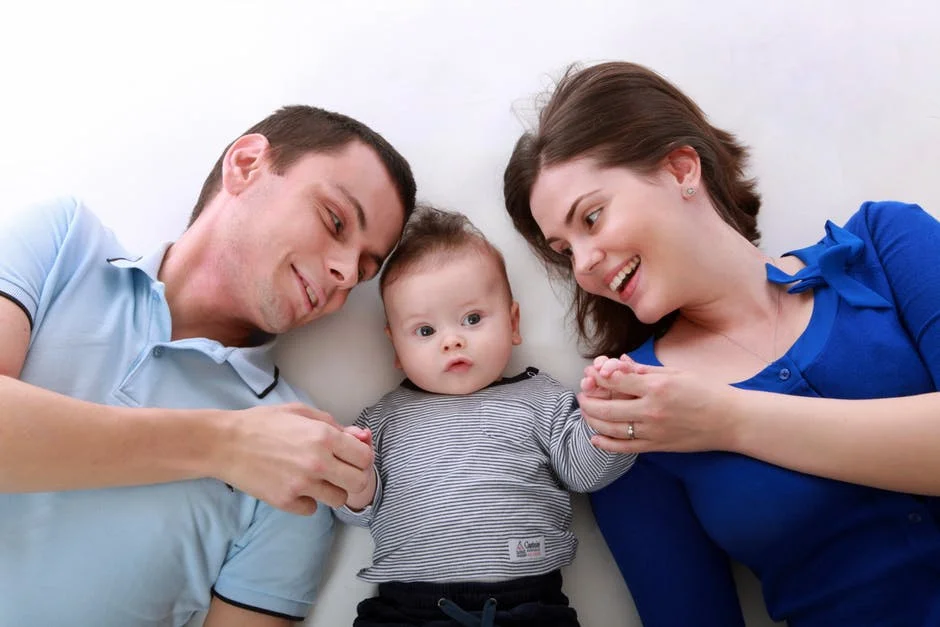
A beginning held in the present Two parents lie beside their baby. Her life is not a means to a demographic result, and her worth is not postponed until she becomes a parent, achieves something, or carries an inheritance onward. Yet all the generations before her have converged in this moment. If she later becomes a mother and her lineage continues across deep time, billions of people may one day descend through her. That is a horizon of possibility, not a prediction. Sheldonl, CC0, via Wikimedia Commons

She is already enough. What comes after her may be large or small, near or unimaginably distant. For now, she is their newborn daughter, held by her father and mother, and the future is still open.