August 2026
When Cleo looks for me
My dog Cleo will sometimes wander into the room where I’m sitting, find me, and then do absolutely nothing.
She doesn’t need to go outside. Her water bowl is full. There’s no mysterious emergency involving a toy trapped under the couch. She just walks in, sees that I’m there, and settles nearby.
This is one of the nicest things about having a dog.
Life Is Electric
There is a strange prestige attached to pessimism. Tell someone that civilization is collapsing and you sound serious. Tell them that the future is probably going to be amazing and you sound a little naive.
We have this exactly backward.
Spend enough time online and you can assemble a pretty convincing case that everything is terrible. Politics is broken. Technology is destroying us. The economy is rigged. The culture is decaying. AI will take everyone’s jobs. Nobody can afford a house. Nobody is having children. The climate is changing. Institutions are failing. Somewhere, at this very moment, a guy with a podcast microphone is explaining why Rome fell.
The Agent That Remembers Why
If you maintain a library of skills for AI agents, there is a fairly mundane problem hiding inside it. The skill files can tell an agent what to do, and Git can tell you how those files changed. Neither necessarily tells the next agent why a particular instruction ended up there.
That history tends to be scattered through execution traces, failed attempts, optimizer logs, benchmark results, and conversations. A useful lesson gets discovered, turned into a skill edit, and then partly disappears into the edit itself. If the edit doesn’t work and gets rolled back, the lesson can disappear almost completely.
The Wheel of Government
There is something wonderfully ambitious about trying to draw the history of government as a circle.
Sometime in the second century BCE, the Greek historian Polybius tried to do roughly that. In Book VI of his Histories, he described a recurring sequence by which political orders emerge, mature, corrupt themselves, collapse, and begin again. The theory is usually called anacyclosis—a cycling or recurring movement—and it gives us one of antiquity’s most memorable attempts to turn political history into a pattern.
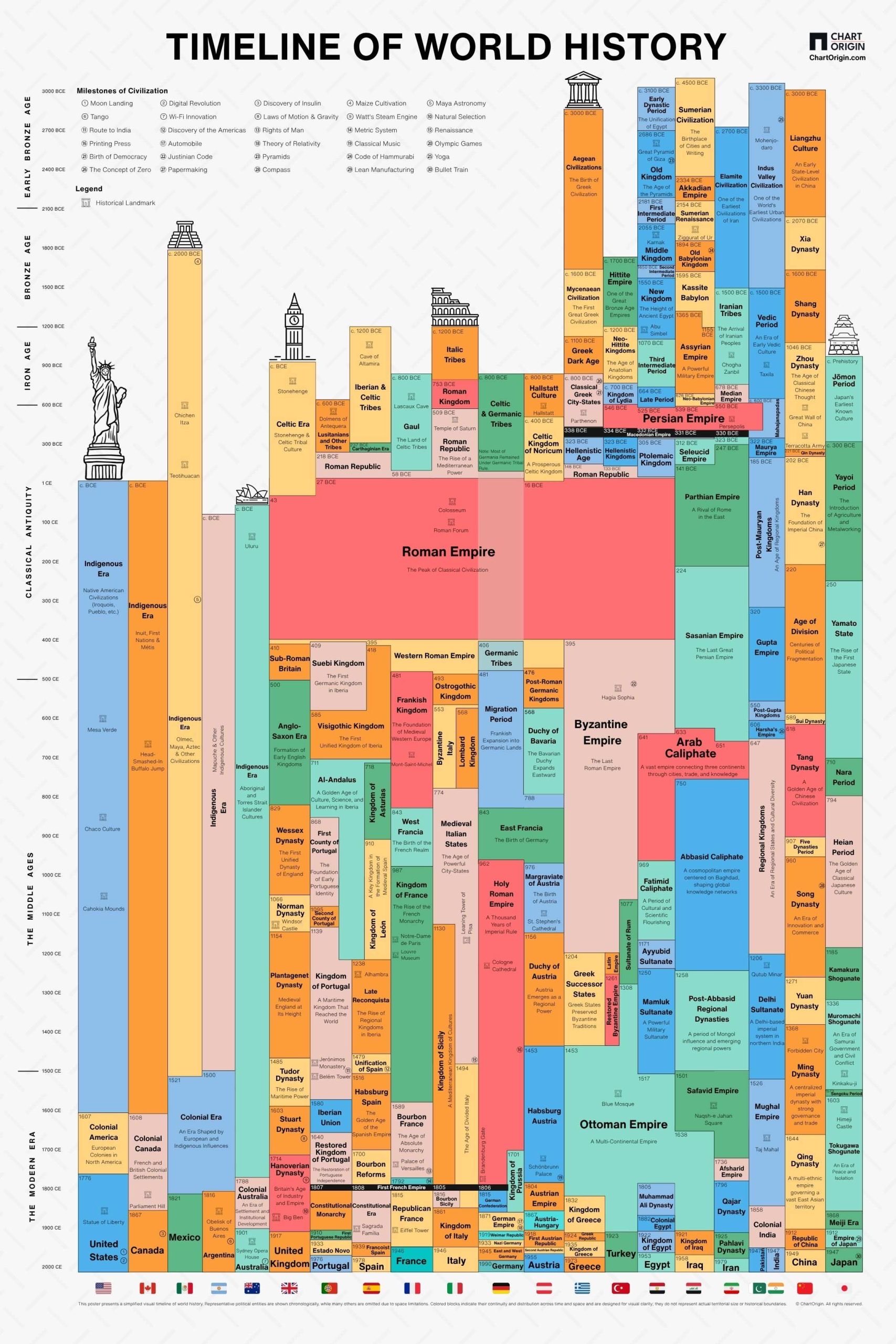
A timeline of world history
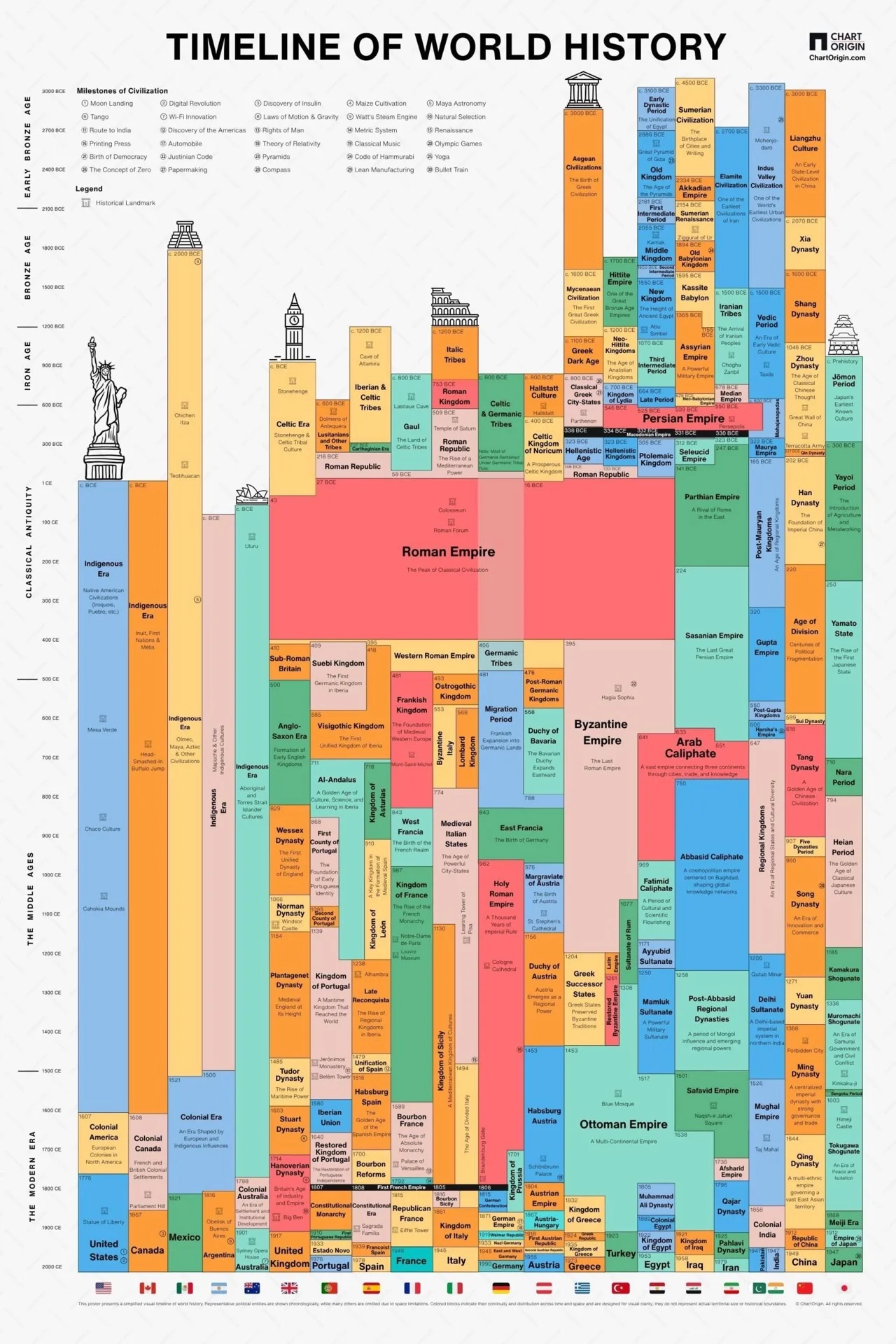
View the full sized version.
The Shape of an Argument
A straight line is a surprisingly powerful thing to mistake for nature.
In 1966, the linguist Robert B. Kaplan published a paper about a problem he kept seeing in the writing of international students at American universities. Many of them knew English quite well. Their grammar worked. Their vocabulary worked. Their sentences, taken one at a time, worked. And yet their essays could still feel strangely difficult to an American reader. The argument seemed to wander, repeat itself, arrive late, or refuse to arrive at all.
The Machine at the Bottom of the Sea
In the spring of 1900, sponge divers sheltering from bad weather near the Greek island of Antikythera found a shipwreck on the seafloor. It was loaded with the sort of ancient treasure people know how to recognize: marble and bronze statues, jewelry, coins, glassware. Divers and archaeologists spent the next year bringing it up.
Among it all was a corroded lump of bronze and wood. It didn’t look like much until it broke apart and someone noticed teeth inside it. Gear teeth.
How America Can Carry $40 Trillion of Debt
The United States crossed $40 trillion in national debt this week. The number is so large that the usual attempts to explain it mostly make it harder to understand. Stack $40 trillion in dollar bills and the pile would reach millions of miles into space. Save a million dollars every day and it would take more than 100,000 years to accumulate that much. Divide it among Americans and you get well over $100,000 per person.
A more useful comparison is to put the debt next to the country’s income. U.S. nominal GDP was running at about $32.5 trillion a year in the second quarter of 2026, which puts the $40 trillion gross debt at about 123 percent of one year’s economic output. If a person earning $100,000 a year had debt in the same proportion, the balance would be about $123,000. Using debt held by the public instead of gross debt, CBO puts the ratio at about 101 percent of GDP this year, almost exactly the equivalent of $100,000 of debt against $100,000 of annual income.
The Price of a Thought
For most of human history, if you wanted another useful thought, you needed another person or more of someone’s time. A calculation needed a mathematician. A translation needed someone who knew both languages. A legal opinion needed a lawyer. A drawing needed a draftsman. Even after computers arrived, most of the judgment surrounding computation still came from people.
We now have machines that can produce a growing range of this work. I wrote recently about what happens when intelligence becomes cheap, and especially what that might do to the excuses we make when knowledge and competent advice are no longer particularly scarce. But there is a more basic question underneath that one: what actually makes intelligence cheap?
Styling Markdown with Kramdown Attributes
Markdown is deliberately limited at visual design. A paragraph is a paragraph, a blockquote is a blockquote, and the author generally doesn’t get to decide that one particular paragraph should become a pull quote, warning box, or oversized introduction. For most writing that is a feature. It keeps content separate from presentation.
Kramdown gives Jekyll sites a useful middle ground. Its Inline Attribute Lists, usually called IALs, let you add classes, IDs, and ordinary HTML attributes to Markdown elements without replacing the Markdown with raw HTML. That makes it possible to build richer editorial layouts while keeping the source readable.
-
→
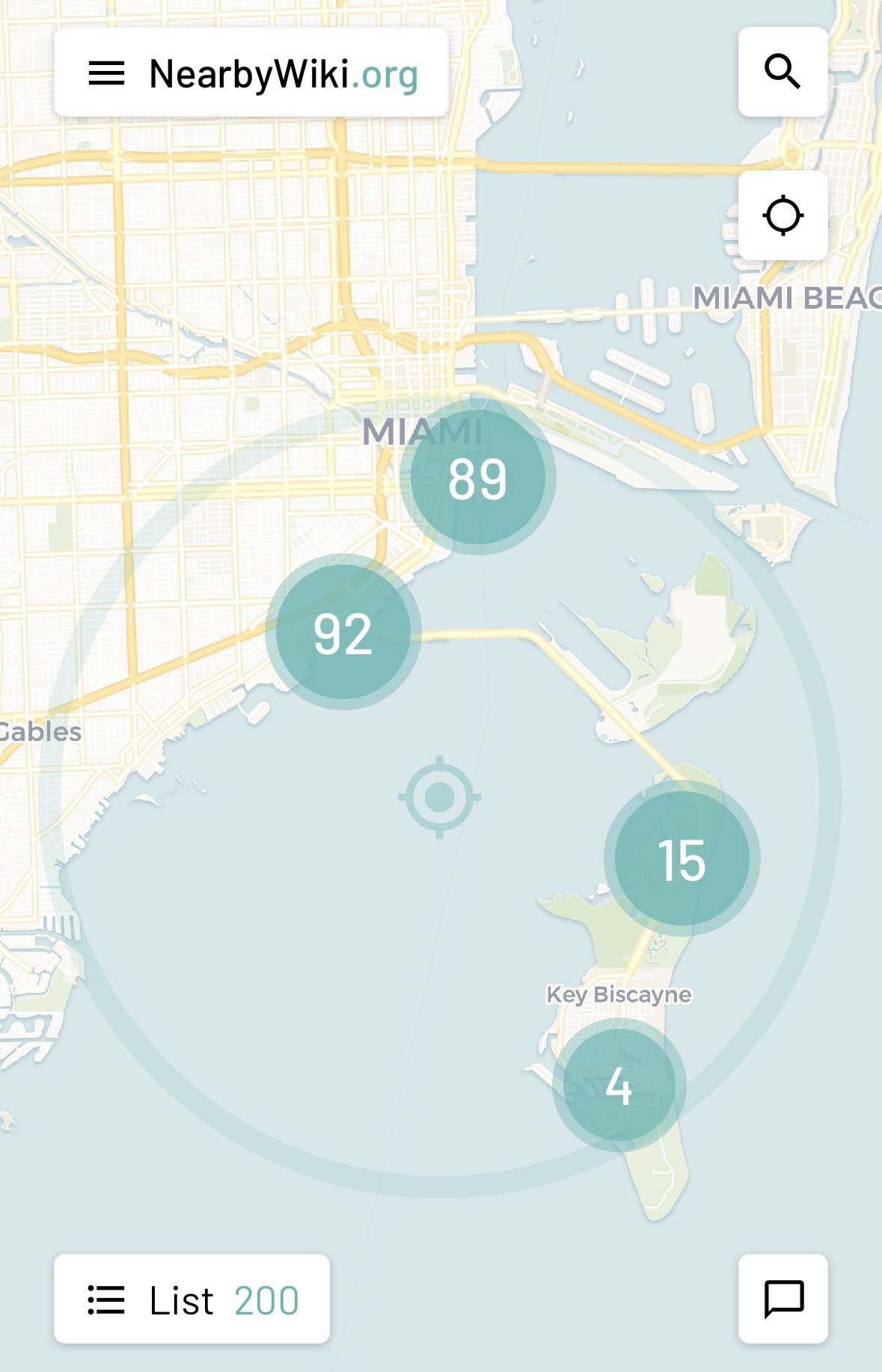
NearbyWiki is a cool site that finds Wikipedia entries near your current location. It’s a project by Hello Digital World
 NearbyWiki
: Wikipedia places nearby
Explore interesting places nearby listed on Wikipedia. Discover sights and destinations in your area or a travel destination.
NearbyWiki
NearbyWiki: Wikipedia places nearby
Explore interesting places nearby listed on Wikipedia. Discover sights and destinations in your area or a travel destination.
-
→
This book won’t teach you how to actually make software - it’s not a tutorial or a guide but rather something more interesting than that. It’s a manual that explains how the things you use everyday actually work.
It won’t make you a better designer or programmer tomorrow - there’s nothing actionable in here. But knowing how things work comes in handy when you find yourself out of your depth. Or at the very least, you can pretend to be smart in front of your friends. You don’t need to be technical to read this - there are a lot of pictures and diagrams to do the heavy lifting. You just need to be curious.
Making Management Smaller
Most management advice is about how to become a better manager. The 37signals Manager Playbook left me thinking more about how much management a company actually needs.
37signals has made the manager’s job surprisingly small. Managers are expected to remain practitioners in their field. The company says managing people “should not take much of your time,” in part because it hires people it expects to operate as “managers of one.” New employees get more attention, as do people who are struggling, but an experienced person doing good work is mostly allowed to keep doing it. The manager is there, but not constantly present.
The Camp Above Hong Kong
High on the saddle between Sunset Peak and Yi Tung Shan, nineteen small stone cabins sit among the grass and clouds. They have no road and, with limited exceptions such as solar equipment installed during recent conservation work, no electricity. The nearest traffic passes far below. From a distance the buildings can look like abandoned military posts, but they are the remains of Lantau Mountain Camp, a Christian summer retreat founded by missionaries working across South China nearly a century ago.
In the mid-1990s, my family stayed there several times. I remember climbing the mountain with my parents and two younger siblings, drinking fresh water along the way, and lighting the kerosene lanterns at night. Those visits are why the camp means something to me, but my family entered a story already seventy years old. The cabins had survived political disorder, a failed camp on another mountain, wartime destruction, the retreat of the missionary community that built them, and the transformation of Lantau Island below. They remain because generations of owners, churches, residents, laborers, and volunteers kept carrying what was needed up the mountain.
-
→
Working Copy supports automation through the Shortcuts app where files and other data can flow between actions. You locate these actions inside Apps > Working Copy.
Use Get Repository Files to get one or several files from a repository that can be passed to other actions. The Path parameters can contain wildcards such as docs/*.md and if it points to a directory all files inside are returned. You can configure the action to only include files with a particular status such as modified and combining this with Path=/ can be useful to get all files with this status.
I’m getting into iOS Shortcuts and Working Copy. The two are a match made in tinkerer’s heaven.
 workingcopy.app
Working Copy - Users Guide - Shortcuts and automation
"Working
workingcopy.app
Working Copy - Users Guide - Shortcuts and automation
"Working
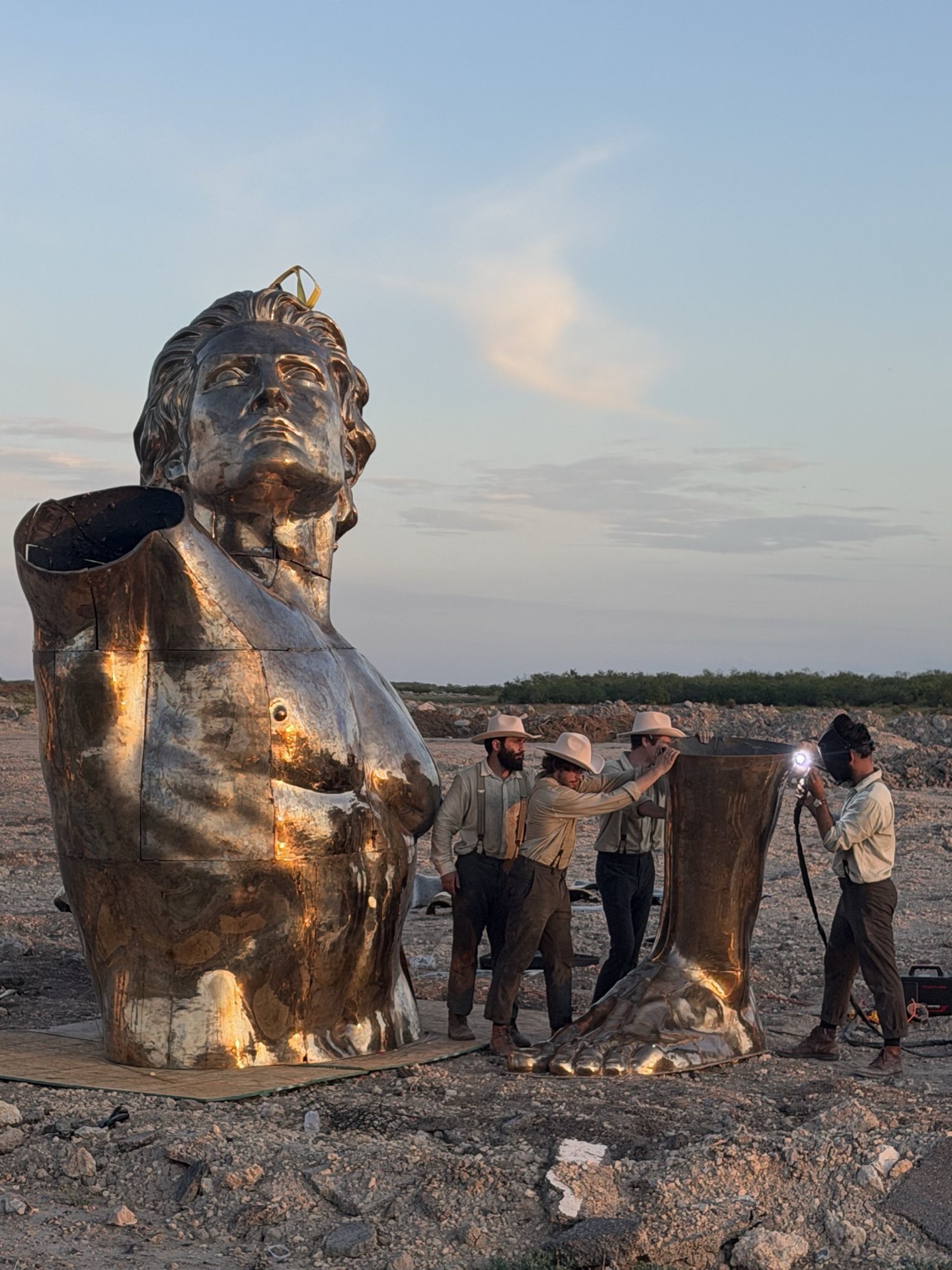
Building Prometheus
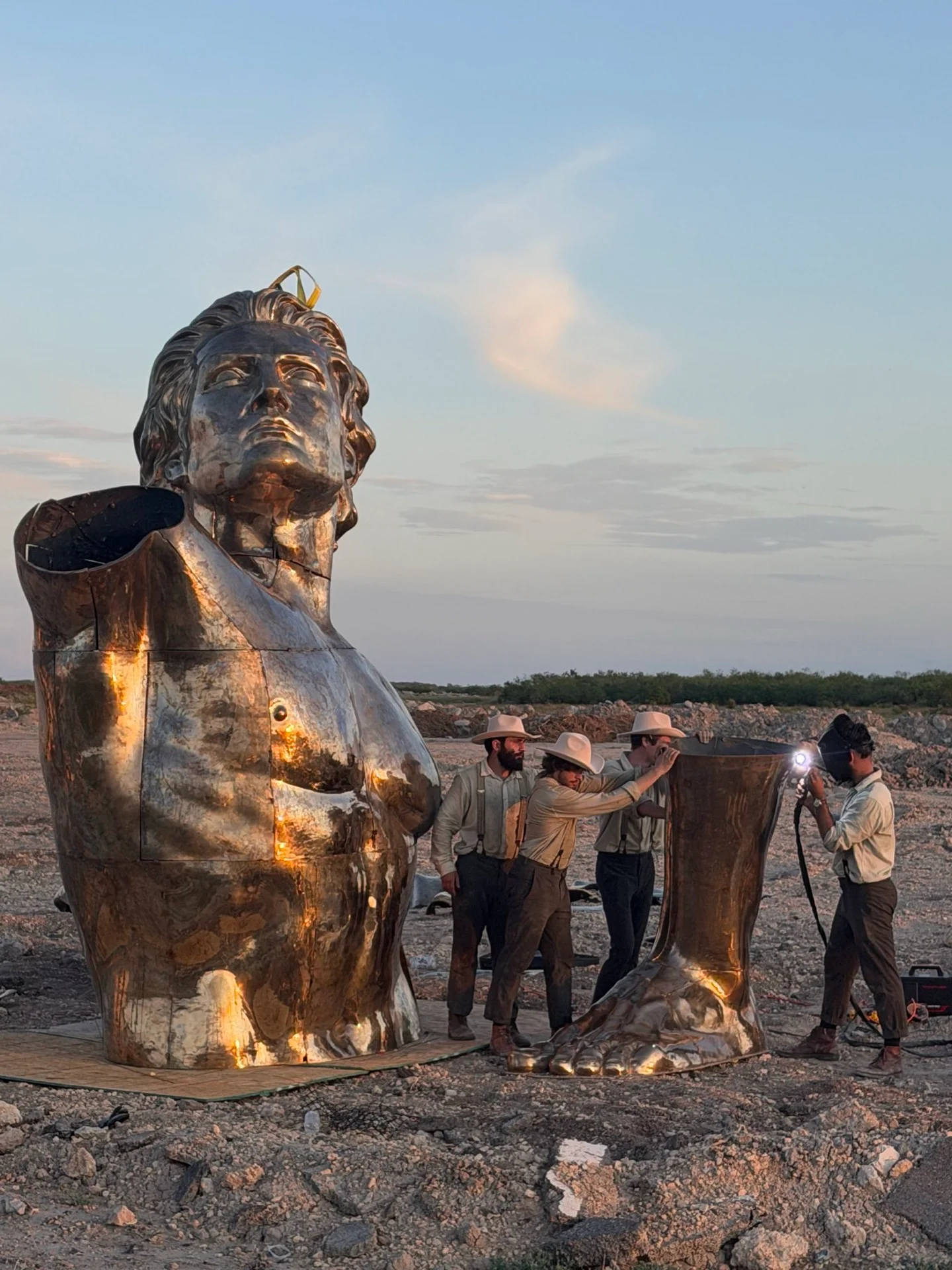
Star Base Prometheus The 50-foot tall statue of Prometheus will be erected at Star Base, TX soon. via Atelier Missor on X
It will be impressive when complete.
Harry Potter Is a Story About Virtue, Not Magic
Seven books give us wands, curses, flying broomsticks, enchanted castles, talking portraits, dragons, ghosts, potions, prophecies, and people who cheerfully call themselves witches and wizards. Yet when the story reaches its biggest moments, magic is rarely what saves anyone. Harry does not defeat Voldemort because he becomes the best wizard. He wins because, over seven books, he learns courage, loyalty, mercy, and finally the willingness to give his life for someone else.
Most of the magic at Hogwarts belongs to the familiar world of fairy tales. Ron says Wingardium Leviosa and a feather rises. A broom flies because this is the sort of story in which brooms fly. Nobody has sacrificed a goat or sold his soul to make the dishes wash themselves. Magic is simply part of the furniture of Rowling’s world. It gives the characters extraordinary abilities without making them better people. A wand gives Draco Malfoy more power than an ordinary schoolboy. It does not make cruelty less cruel.
When Intelligence Becomes Cheap
There are questions people ask because they want answers, and there are questions they ask because they are not ready to have them answered.
Someone says, “I don’t know what I should do with my career,” and it sounds like a request for information. Maybe it is. But sometimes the unanswered question has become useful in its own right. As long as it remains open, the future remains open with it. No decision has been made, no sacrifice accepted, no failure risked.
A Computer with a Signature
On Friday, David Heinemeier Hansson shipped Omarchy 4.0, called it Quattro, and said it was one of the greatest software releases of his professional career. That is a large sentence from a man who already wrote Ruby on Rails. The launch video is an hour and a half. He posted a forty-five-second install on a fast AMD machine and thanked a long list of other people, including the authors of Hyprland and Quickshell, before ending the thread the way he meant it: computers should be fun.
I have not installed it. What follows is a reading of a release, a doctrine, and the noise a signed desktop still makes in a culture that prefers its operating systems to arrive without a name on them.
The Paradox of Cyber
Deloitte’s fifth Future of Cyber Survey, based on 1,058 respondents, finds that 85% are somewhat or very confident in their organization’s cybersecurity strategy. They report strong executive sponsorship, access to funding, modern security architectures, and increasingly integrated planning. Yet the same respondents report implementing the actions that make those strategies real at a lower rate. The average gap between confidence and readiness is 15 percentage points.
Deloitte calls the five tensions it found the confidence, influence, vendor, breach, and budget paradoxes. Read together, they describe less a collection of cybersecurity problems than a problem of organizational execution. Security has become good at getting attention from senior leadership. It is less consistently embedded in the decisions, systems, relationships, and operating processes where risk actually accumulates.
The Best Startup Directory Is a Time Machine
Imagine having a list of every startup someone was building in 2007, including the ones that looked too strange to take seriously.
Most would have failed. Some would have disappeared without a trace. A few would have looked ridiculous. But mixed in with them would have been early versions of ideas that later became ordinary parts of the internet.
Early.tools offers a version of that view today. It is a human-curated directory of pre-launch startups and early-stage tools, with products grouped by stage from waitlist to launched. The site is less useful as a prediction market than as a record of what founders are trying to make while the boundaries of a new technology are still moving.
-
→
xai-org/x-algorithm: Algorithm powering the For You feed on X
This repository contains the core code that determines which posts a viewer sees in the For You feed on X. It combines in-network content (from accounts the viewer follows) with out-of-network content (discovered through ML-based retrieval and other mechanisms), filters content based on a variety of inputs, and ranks posts using a transformer model.
The full xAI “For You” algorithm is open source and available on GitHub.
GitHub GitHub - xai-org/x-algorithm: Algorithm powering the For You feed on X Algorithm powering the For You feed on X. Contribute to xai-org/x-algorithm development by creating an account on GitHub.
-
→
It’s eight o’clock. The apartment is quiet, aside from the music playing softly over the speaker. It’s a playlist your friend made for you years ago. You send them a text to check in, then pick up a book, flick on the lamp, and settle into the chair to read.
This is a gorgeous site and sentiment.
 Ordinary Abundance
A walk through a modern apartment, through the eyes of the people for whom everything in it was new.
Ordinary Abundance
Ordinary Abundance
A walk through a modern apartment, through the eyes of the people for whom everything in it was new.
-
→
Your brain doesn’t see reality — it tries to predict it - Big Think
Our brains are gambling addicts placing bets on what reality holds. And sometimes, they bet wrong.
-
→semi-rad.com Do It 14,000 Times Slower With This One Trick – Semi-Rad.com
Do It 14,000 Times Slower With This One Trick – Semi-Rad.com
Fun comic. Hat tip to daring fireball.
-
→
A library that should stay in a links stream even when the preview card is turned off.
-
→
Wikipedia’s overview of RSS is a useful reminder of why a dedicated links feed is worth having.
 en.wikipedia.org
RSS - Wikipedia
en.wikipedia.org
RSS - Wikipedia
-
→
The GitHub Copilot app is the only desktop experience for agent-driven development built natively on GitHub. Available for macOS, Windows, and Linux, on any Copilot plan, or bring your own key.
Starting to experiment with this. It could be interesting to use.
 GitHub
 Copilot app
The GitHub Copilot app is the only desktop experience for agent-driven development built natively on GitHub for macOS, Windows, and Linux.
GitHub
GitHub Copilot app
The GitHub Copilot app is the only desktop experience for agent-driven development built natively on GitHub for macOS, Windows, and Linux.
-
→
vas on X: “https://t.co/haApURmzAN” / X
It might not feel like you’re in the top 1% because you see nerds on X spinning up agent fleets on a whim, but trust me, you’re in the top 1%. You’re likely using a model every day, you have opinions about how best to use it, and you maybe even tinker with agents or have set up Hermes on your own machine.
X (formerly Twitter) vas (@vasuman) on X AI Adoption is a Myth
-
→
Pope: Like a stream leading to its source, music leads us to God - Vatican News
Music can lead us beyond the threshold of mystery. Just as someone following a stream eventually reaches its source, the beauty of song can guide us towards God, satisfying the thirst for meaning and happiness that the world itself cannot quench.
This was the image Pope Leo XIV offered in his reflection during the Canticle of Peace gathering, held this evening, 29 July, at Borgo Laudato si’ in the Pontifical Gardens of Castel Gandolfo, beneath the shade of the ancient holm oak known as “Methuselah.”
This is something I should share with Gaby.
 www.vaticannews.va
Pope: Like a stream leading to its source, music leads us to God - Vatican News
Pope Leo joins the prayer gathering 'Canticle of Peace' at Borgo Laudato si', in the Pontifical Gardens of Castel Gandolfo, together with Andrea ...
www.vaticannews.va
Pope: Like a stream leading to its source, music leads us to God - Vatican News
Pope Leo joins the prayer gathering 'Canticle of Peace' at Borgo Laudato si', in the Pontifical Gardens of Castel Gandolfo, together with Andrea ...
-
→
The Gervais Principle, Or The Office According to “The Office” — Ribbonfarm
Until now, that is. Now, after four years, I’ve finally figured the show out. The Office is not a random series of cynical gags aimed at momentarily alleviating the existential despair of low-level grunts. It is a fully realized theory of management that falsifies 83.8% of the business section of the bookstore. The theory begins with Hugh MacLeod’s well-known cartoon, Company Hierarchy (below), and its cornerstone is something I will call The Gervais Principle, which supersedes both the Peter Principle and its successor, The Dilbert Principle.
 Ribbonfarm
The Gervais Principle, Or The Office According to "The Office"
My neighbor introduced me to The Office back in 2005. Since then, I've watched every episode of both the British and American versions. I've watched the show…
Ribbonfarm
The Gervais Principle, Or The Office According to "The Office"
My neighbor introduced me to The Office back in 2005. Since then, I've watched every episode of both the British and American versions. I've watched the show…
How to Tell AI Writing from AI Slop When AI Writing Is Getting Hard to Spot
There was a time when spotting AI writing was easy. You would read three paragraphs and encounter “delve,” “tapestry,” or “ever-evolving landscape,” and there it was, standing in the middle of the room wearing a name tag that said HELLO I AM A LANGUAGE MODEL. Those days are disappearing remarkably quickly. Modern AI can write a competent email, a persuasive essay, a product review, a joke that is almost funny, or a sentence that sounds exactly like the person who asked for it. The machine has learned to imitate the surface of ordinary prose with increasing skill, quietly improving its ability to pass the smell test while the rest of us argue about whether the smell test was ever robust in the first place.
The question isn’t whether AI can write. The question is whether we can tell when it did.
You Don't Learn AI. You Learn a New Way of Working.
Three years ago, Byun Kyuhyun used Claude much as he had used a search engine. When he had a programming question, he asked it. If he needed to know how to delete from a Go map while iterating, Claude was simply a faster alternative to searching Stack Overflow.
That is not how he uses it now. In describing his current workflow, Kyuhyun says he gives the model more context, asks it to question him before answering, compares alternatives, and uses it as a kind of rubber duck that talks back. He sometimes separates jobs between Claude and Codex and uses one to check the other. The change, he argues, is not just that he learned better prompts. The way he thinks alongside the tools changed.
The AI Employee Needs a Computer
We have plenty of AI agents, but xAI’s new Grok Bot is an agent that gets its own computer.
That sounds almost disappointingly mundane. We have spent years imagining AI as something that lives inside a model: a vast intelligence that can write, reason, code, analyze documents and answer questions. Give it a computer, however, and the nature of the problem changes. The computer stops being the thing the human uses to access the AI and becomes the thing the AI uses to work.
The Fire-Bearer at Starbase
Prometheus belongs beside a rocket factory.
At Starbase, on the southern edge of Texas, Atelier Missor, a French classical foundry, is assembling a roughly 50-foot bronze statue of the Greek Titan. He stands with his torch raised, less like an ornament for an industrial site than a visitor from the ancient world who has wandered into the space age.
The image is strange, and it is also coherent. Prometheus stole fire from the gods and gave it to humanity. Fire is one of the oldest symbols of technology itself: the power to transform the world, make tools, cook food, work metal, and light the dark. At Starbase the metaphor is almost literal. A rocket takes controlled fire and turns it into motion, carrying people and machines beyond the atmosphere and, one day, to other worlds.
Why Chesterton's Lepanto Still Matters
There are poems that describe a battle, and there are poems that make a battle feel like a judgment on the people who entered it. G. K. Chesterton’s Lepanto is the second kind. It is not content to tell us that Christian fleets defeated the Ottoman navy on October 7, 1571. It asks what happens when a people that has grown divided, comfortable, and uncertain suddenly discovers that the things it has inherited are not self-preserving.
That question is what makes the poem worth returning to. Read Chesterton’s Lepanto at the Poetry Foundation before going further. The poem itself is the primary source for everything that follows: its argument is not merely in what Chesterton says, but in the music, images, contrasts, and moral imagination with which he says it.
The Man Who Read the Internet for Me
For years, one of my small pleasures was reading James Taranto’s Best of the Web.
It was a strange thing to look forward to. It was a daily column about politics, journalism, and whatever else had caught the attention of the editor of the Wall Street Journal’s online editorial page. It was mostly links to other people’s work, with Taranto’s comments attached. Sometimes the comments were serious. Often they were funny. Sometimes the joke was nothing more than a headline followed by another headline that made the first one look ridiculous.
The Great Un-Learning: Why Forgetting Old Skills Matters as Much as Acquiring New Ones
When the tide goes out, you see who’s swimming naked.
In the AI era, the tide is reversing course. Global AI spending will top $200 billion this year, yet most companies get disappointing returns. Leaders blame the tech. Bad data. Immature models.
They’re wrong. The real problem is human. It’s not what people can’t learn. It’s what they refuse to unlearn.
Designing an Editorial Page for Robot Vacuums
I’ve enjoyed using Grok 4.5 to generate editorial webpages on a variety of subject. The most recent one was an attempt to test out some of the fonts and typography that would go into the August redesign of this site. Below is what went into the design.
Most product pages about robot vacuums look the same. White background, floating cards, gradient buttons, and a carousel of “best overall” badges. The brief here was different: take the dense Grokipedia entry on robotic vacuum cleaners and turn it into a single-page editorial feature that could sit comfortably next to a long New Yorker tech essay or a well-set Cabinet magazine article.
When Will the First American Pope Come Home?
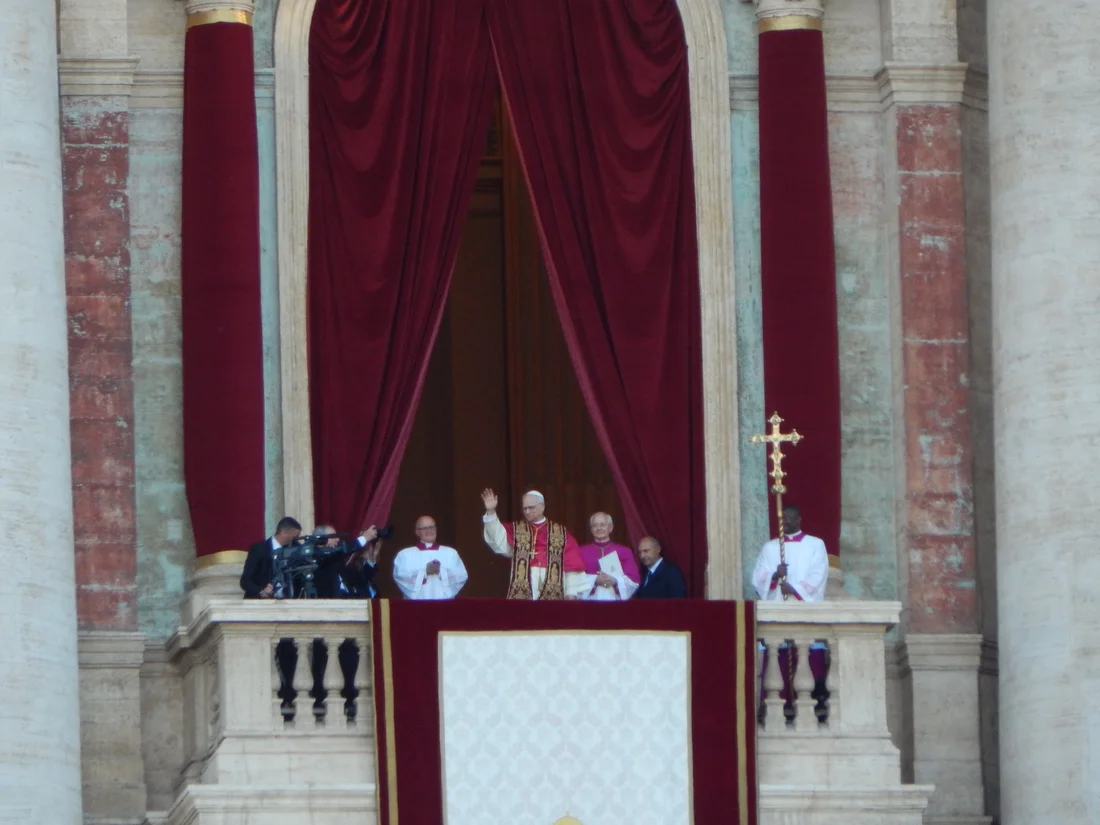
Pope Leo XIV has been on the road. Turkey and Lebanon last November. Algeria, Cameroon, Angola, and Equatorial Guinea in April. Spain in June. A deliberate stop on the migrant island of Lampedusa on the Fourth of July. Peru is still expected later this year.
The one place he has not set foot is the United States.
The Unsung Workhorse of the Open Web: Inside jsDelivr
If you have inspected network requests on a modern web page, you have encountered
cdn.jsdelivr.net. It sits behind millions of web applications, serving minified JavaScript libraries, CSS frameworks, fonts, and assets without charging a cent.Yet, compared to commercial infrastructure providers or high-profile open-source foundations, jsDelivr operates with remarkably little fan-fare. It is a critical piece of global utility infrastructure hiding in plain sight—a multi-CDN network that routes petabytes of traffic every month to keep the open web fast, accessible, and resilient.
The Rhyme of the Machine
If you spend enough time reading on the web today, you start to feel an unsettling sense of linguistic déjà vu. Every third essay opens with a sweeping observation about an “ever-evolving landscape.” Every critique pivots on a dramatic reframe (“It’s not X—it’s Y”). Every product announcement promises to “quietly orchestrate” your life while honoring the “rich tapestry” of modern work.
We are drowning in synthetic cadence. Generative models haven’t just automated prose; they’ve standardized a dialect.
The Blog That Is a Single File
Someone built a site called claude-blog.md that is, quite literally, just a raw Markdown file rendered directly in the browser. No static site generator, no serverless hydration layer, no build steps, and no dynamic client-side router running three separate JS workers. Just text and a clean parser.
It brings back memories of the early web’s best impulse: fetching a raw document across a wire, reading it, and moving on with your day.
The Accidental Wallpaper of the Modern Web
In 2013, a Montreal startup called Crew was bleeding money. To stay afloat, they hired a photographer to shoot custom imagery for their website, but ended up using only a fraction of the photos. Instead of letting the remaining high-resolution files languish on a hard drive, founder Mikael Cho posted ten leftover photos to a simple $19 Tumblr blog with a single instruction: “Do whatever you want with them.”
That humble Tumblr feed grew into Unsplash—the web’s default visual infrastructure.
Embed examples
Paste a supported URL on its own line in a Markdown file and the build turns it into a responsive embed.
AI Video
When Canadian Wildfires Reach Florida: The Hidden Impact on Tourism
Every year, millions of visitors choose Florida for its beaches, outdoor attractions, golf courses, and sunshine. But increasingly, events happening more than a thousand miles away are shaping the visitor experience in the Sunshine State.
One of the most surprising examples is the growing influence of Canadian wildfires.
In recent years, massive wildfires across Canada have produced smoke plumes large enough to travel across much of North America. In May 2025, satellite imagery showed smoke from Canadian wildfires spreading through the Midwest and reaching northern Florida, prompting air quality concerns far from the fires themselves. According to reporting from WGCU Public Media, NOAA imagery captured a broad swath of smoke reaching into the state as wildfire activity intensified across several Canadian provinces. 【1-7dcd8c】
SpaceX’s First Earnings Report: A High-Stakes Test of Belief
SpaceX has spent years operating in a world of private funding rounds, long-term bets, and founder-driven narratives. This week, it enters a different arena.
The company is set to release its first quarterly earnings report as a public company following its June IPO, and Wall Street is watching closely. Not just because of the numbers, but because of the extraordinary divide between believers and skeptics.
How I built jonathanfrei.com V5
This is the build log from my side of jonathanfrei.com V5: what the constraints were, what I wrote into the repo, and where the code actually broke.
I did not invent the product. Jonathan answered a configuration questionnaire first—personal site, English, GitHub Actions (not the classic
github-pagesgem), custom minimal CSS with system dark mode, accessibility and mobile-first defaults, domain on Cloudflare, plain Markdown, solo contributor, drafts in an obfuscated public folder, no comment system, no non-standard plugins. Repo name came later:jonathanfreidotcomV5. Those answers were the spec.Easy URL embeds in Markdown
You can handle multiple platforms embeds—like YouTube, X (Twitter), Instagram, Vimeo, and Spotify—with a single client-side JavaScript approach or a Ruby plugin hook.
Because platforms like X and Instagram use full interactive widgets rather than simple
<iframe>elements, using JavaScript is usually the most reliable solution.This script checks paragraphs in your content for standalone URLs from supported platforms and swaps them out with their corresponding responsive embed HTML or platform scripts.
Building V5 with an AI coding partner
I decided to rebuild my personal site again, now at v5. The previous stack had done its job, but I wanted something new I could use to begin publishing again and learn some new technologies. So I decided to build a clean Jekyll site on GitHub Pages, Markdown-first writing, a custom domain still sitting behind Cloudflare, and enough structure that I could keep shipping posts without wrestling the tooling every time.
I did most of the work in conversation with Grok 4.5. Not as a one-shot “make me a website” prompt. More like a multi-turn build log: plan first, execute against a named repo, then chase open issues and a few features that only made sense once the skeleton was live.
The Fire Next Time: Why Our Forest Policy Is Just Arson
When three separate wildfires blew up across Spokane County this August, burning through thousands of hectares and sending 60,000 people packing, local officials pulled out the standard script: record heat, shifting winds, bad luck. You can read the play-by-play in The Spokesman-Review or check The Business Journal for the staggering price tag on destroyed homes.
Weather provides the spark, but fuel builds the bomb. And when you spend a century letting dead timber and overgrown brush stack up until a forest looks like a game of Jenga played with matches, calling the outcome a “natural disaster” is just bad accounting. It’s organizational negligence. And when that negligence guarantees a town burns down every August, it’s just slow-motion arson with better paperwork.
Hello, V5
This is the first post on the new version of the site.
Built with Jekyll, deployed by GitHub Actions, and served behind Cloudflare. The design is intentionally minimal so it can grow into custom article layouts, a portfolio, or a photo gallery later without fighting the foundation.
Drafts live in an obfuscated folder that is excluded from the public build, indexes, feeds, and robots.txt.